
By Harrison Lowell, Guest Author
That "cedar-scented" box of mothballs your grandmother swore by isn't cedar at all — US mothballs are built on one of two actives, naphthalene or paradichlorobenzene, and Enoz’s cedar-scented Moth Bar is paradichlorobenzene 99.68% — an EPA-registered fumigant, scented to smell like cedar so it reads as natural. Mothballs are genuinely effective against clothes moths, and they're also a chemical fumigant you're storing inside closed containers next to the sweaters you'll wear against your skin. Here's what works without it — starting with the trap Dr. Killigan's built when the glue traps of the day weren't doing the job.
At a glance
| Clothing Moth Trap (Dr. Killigan's) | Enoz Moth Bar (Cedar Scented) | Trap a Pest (budget glue trap) | |
|---|---|---|---|
| Price | $24.97 / 6 traps ($4.16/trap) | $22.31 / 3 units ($7.44/unit) | $9.88 / 8 traps ($1.24/trap) |
| Mechanism | Double-potent pheromone + glue | Chemical fumigant vapor | Pheromone + glue |
| Active ingredient | None — pheromone lure and glue | Paradichlorobenzene 99.68% (EPA Reg. No. 1475-113) | None — pheromone lure and glue |
| Rating | 4.9★ | 4.1★ | 4.2★ |
Prices and ratings were checked in August 2026 — ours on drkilligans.com, Enoz’s at Walmart, where the 3-pack carries 4.1★ across 69 ratings, and Trap a Pest’s on Amazon, where the 8-pack carries 4.2★ across 3,233 ratings. Our own price is list price and may be lower during a sale — check the current listing.
Why this trap exists at all
Most pheromone-and-glue clothes moth traps on the market today work roughly the same way — Catchmaster, MaxGuard, Trap a Pest, BugMD, Professor Killamoth, over a dozen near-identical options at every price point from $1.24 to $13 per trap. Dr. Killigan's built its own trap because the lures on the shelf were too weak to reliably draw moths out of a closet — its double-potent formulation carries a heavier dose of pheromone than a conventional trap.
That same heavier lure is what took the trap outside the home. Museums — the Smithsonian among them — along with pest control companies, rug manufacturers, clothing retailers and feed stores use these traps professionally, where a weak lure means a missed infestation in a collection or a warehouse rather than one sweater.
The two vapor-based outliers
Across the wider moth-control aisle, two products work by vapor rather than by trap: TERRO's "Clothes Moth Killer," which uses transfluthrin at 0.95% (EPA Reg. No. 149-25), a synthetic pyrethroid vapor, and Enoz's cedar-scented Moth Bar, which is paradichlorobenzene 99.68% (EPA Reg. No. 1475-113). Everything else in the pheromone-and-glue category, including most of Dr. Killigan's direct competitors, works the same way: a lure and an adhesive, with no active ingredient. So among pheromone traps, the differentiation isn't "ours is the one without the chemical" — none of them have one. It's how hard the trap pulls.
The honest trade-off
A pheromone trap catches adult males. It doesn't touch eggs or larvae — and larvae are what actually eat the wool. If moths are already in a sweater, traps break the breeding cycle rather than stop the damage in front of you. That's the trade against a fumigant, which saturates a closed container and doesn't discriminate: you give up the kill-everything effect and get something you can leave in an open closet, plus a read on whether you have moths at all.
Price, honestly
Several budget glue-trap competitors (Trap a Pest, generic multi-packs) undercut Dr. Killigan's per-trap price by 40–70%. If price-per-trap is the only variable, those are real, legitimate options in the same trap category. The case for paying more here is potency and track record, not toxicity.
Why trust Dr. Killigan's: Dr. Killigan's is a pioneer in minimum-risk pest control, formulating plant-based solutions alongside a practicing entomologist. Every product is evaluated against the actual pest it's meant to kill before it ships. "Natural" isn't the finish line. Proven is.
FAQ
Is there a fumigant-free alternative to mothballs that actually works?
Yes — double-potent pheromone and glue traps target and remove adult male moths before they can reproduce, without the fumigant chemicals in traditional mothballs.
Are "cedar scented" mothballs actually made of cedar?
No — most, including Enoz's, are paradichlorobenzene, a synthetic fumigant, scented to smell like cedar rather than made from it.
How is this different from other pheromone traps on the market?
Most pheromone-and-glue traps work the same basic way. What differs here is the strength of the lure and the professional track record behind it, not the mechanism.
Do I need to combine this with cedar or another repellent?
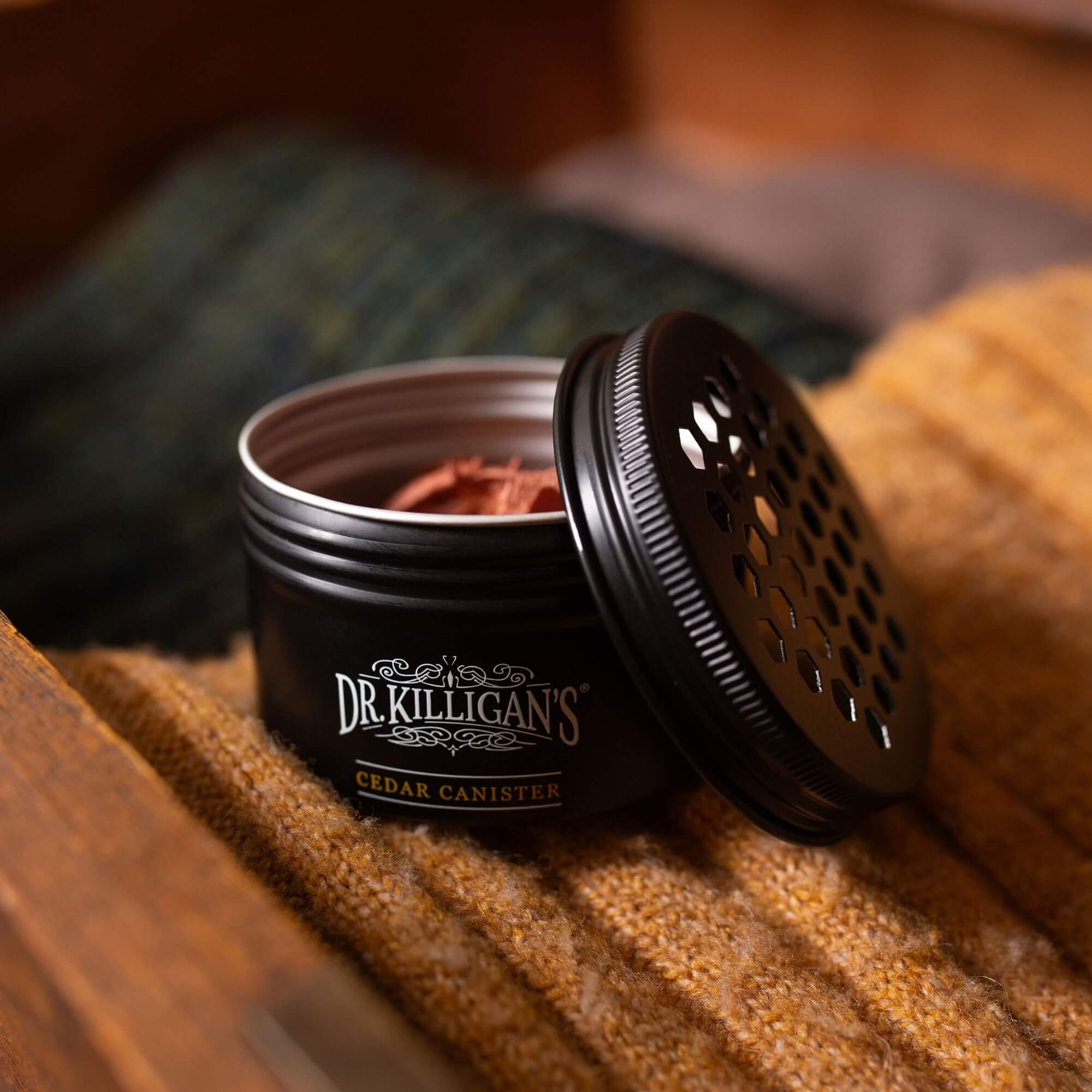
Many households pair traps (which catch and remove existing moths) with cedar products, whose cedarwood oil repels new ones, for full closet protection.
Bottom line
If you're comparing pheromone traps on price alone, several budget options exist. If you're comparing mothballs to traps, the choice is really a fumigant chemical against a trap that pulls harder without one.
Related reading
- Pantry Moth Traps Compared: What Lure Strength Actually Changes
- Best Smelling Cedar Blocks for Your Closet: What Keeps Cedar Working
- Cedar Planks That Actually Smell Good — and Keep Working
Featured in this article
Shop Dr. Killigan's Essentials

Clothing Moth Trap (6 Pack) - Double Potent Pheromone & Glue Formula - Protect Your Closet

Cedar Planks (10 Pack) - Premium Clothing Moth Repellent – 100% Natural Protection