
Published August 28, 2026
Reviewed by Julie Miller, BA in Language Arts, Editorial Lead, Dr. Killigan’s
TL;DR: To get rid of yellowjackets, first locate the nest and determine whether its entrance is accessible. Ground nests and other reachable nest entrances may be suitable for DIY treatment, while harder-to-reach nests call for a more cautious approach. For accessible nests, treat when yellowjackets are least active and follow the product label exactly.
Yellowjackets become a bigger problem when they stop passing through and start returning to the same place. A steady stream into a hole in the ground, gap in siding or protected opening usually tells you more than a single insect hovering around the yard.
This guide walks through how to identify yellowjacket activity, tell yellowjackets from other wasps, decide when DIY treatment makes sense and choose the right response for the nest you find.
What are yellowjackets?
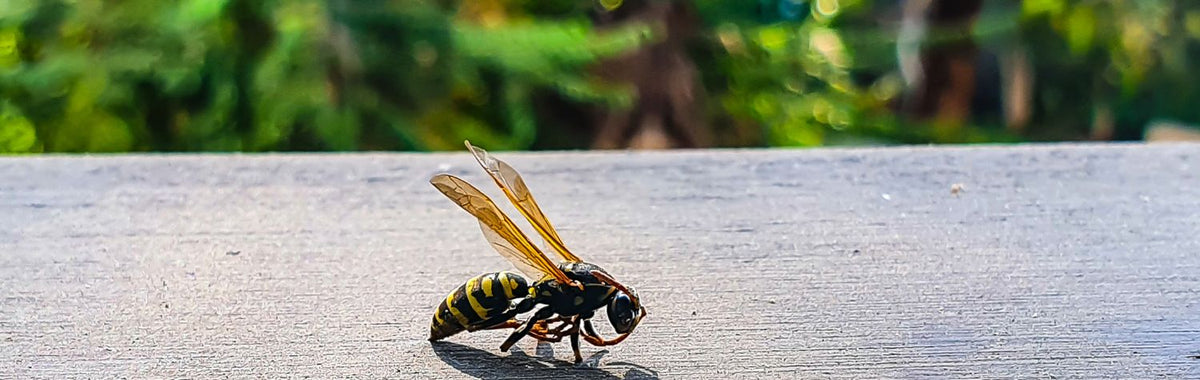
Yellowjackets are social wasps in the genera Vespula and Dolichovespula. Unlike solitary wasps, they live together in colonies and cooperate to build and defend a nest. Their bodies are generally smooth rather than fuzzy, with the familiar black-and-yellow or black-and-white markings that vary by species.
They play a useful role outdoors. Yellowjackets hunt insects and other small prey and some species help reduce populations of insects we consider pests.
They become more of a concern when a colony settles close to everyday activity—near walkways, patios, play areas, lawns or entrances to the home.
Yellowjacket vs. wasp: What’s the difference?
“Wasp” is the broad category. A yellowjacket is one particular kind of wasp.

The easiest household distinction is often the nest, not the color.
Paper wasps commonly build exposed, umbrella-like nests beneath eaves, railings, overhangs and similar protected surfaces. Yellowjackets are more likely to conceal the paper nest itself underground or inside a protected cavity. Seeing insects repeatedly vanish through a small opening can therefore tell you more than trying to study their markings while they are moving.
Yellowjackets can also be mistaken for bees. Look for a comparatively smooth, sharply defined body rather than the denser hair associated with many bees. If you’re still unsure what’s buzzing around your home, our guide to honey bees vs. yellowjackets takes a closer look at their appearance, behavior and nesting habits.
Where do yellowjackets build nests?
Yellowjackets do not all choose the same kind of nest site. Many species build concealed nests underground, while others use wall voids, attics or above-ground locations.
| Yellowjacket type | Common nest location |
|---|---|
| Eastern yellowjacket (Vespula maculifrons) | Usually underground, often in old rodent burrows or other soil cavities |
| Western yellowjacket (Vespula pensylvanica) | Commonly underground in abandoned burrows, but may also use building cavities |
| German yellowjacket (Vespula germanica) | Often uses enclosed spaces such as wall voids, attics and other structural cavities |
| Aerial yellowjackets (Dolichovespula spp.) | Build above-ground paper nests in trees, shrubs or on structures. This group includes the bald-faced hornet (Dolichovespula maculata) |
Note: Ground nests can be especially easy to overlook because the paper nest itself stays hidden below the soil. In some species, a tunnel may lead from the visible entrance to a nest located farther underground.
When are yellowjackets most active?
Yellowjackets are generally most noticeable in late summer and early fall, when colonies reach their largest populations.
Colonies start small in spring and grow steadily through summer as more workers emerge.
At the same time, natural insect prey and plant-based food sources often become less plentiful. Maturing larvae also produce less of the sugary secretions adult yellowjackets rely on for energy. As a result, workers begin searching more actively for other sources of sugar and protein, including soda, fruit and meat.
These changes in colony size and food availability can affect yellowjacket behavior around the nest. To learn more about what drives that behavior, see our guide to why wasps get aggressive.
Should you remove a yellowjacket nest yourself?

Yes, if the nest is accessible and you can treat it without putting yourself in the insects’ flight path.
That is where Final Hex is especially useful. Its high-output stream reaches up to 15 feet, allowing you to treat the nest from a greater distance. The 360-degree actuator lets you spray from different angles.
For an accessible ground nest entrance or another reachable nest, those features make DIY treatment more practical and controlled.
If the nest is hidden deep inside a wall, difficult to reach or impossible to approach safely, DIY treatment is not the right choice.
Featured in this article
Shop Dr. Killigan's Essentials
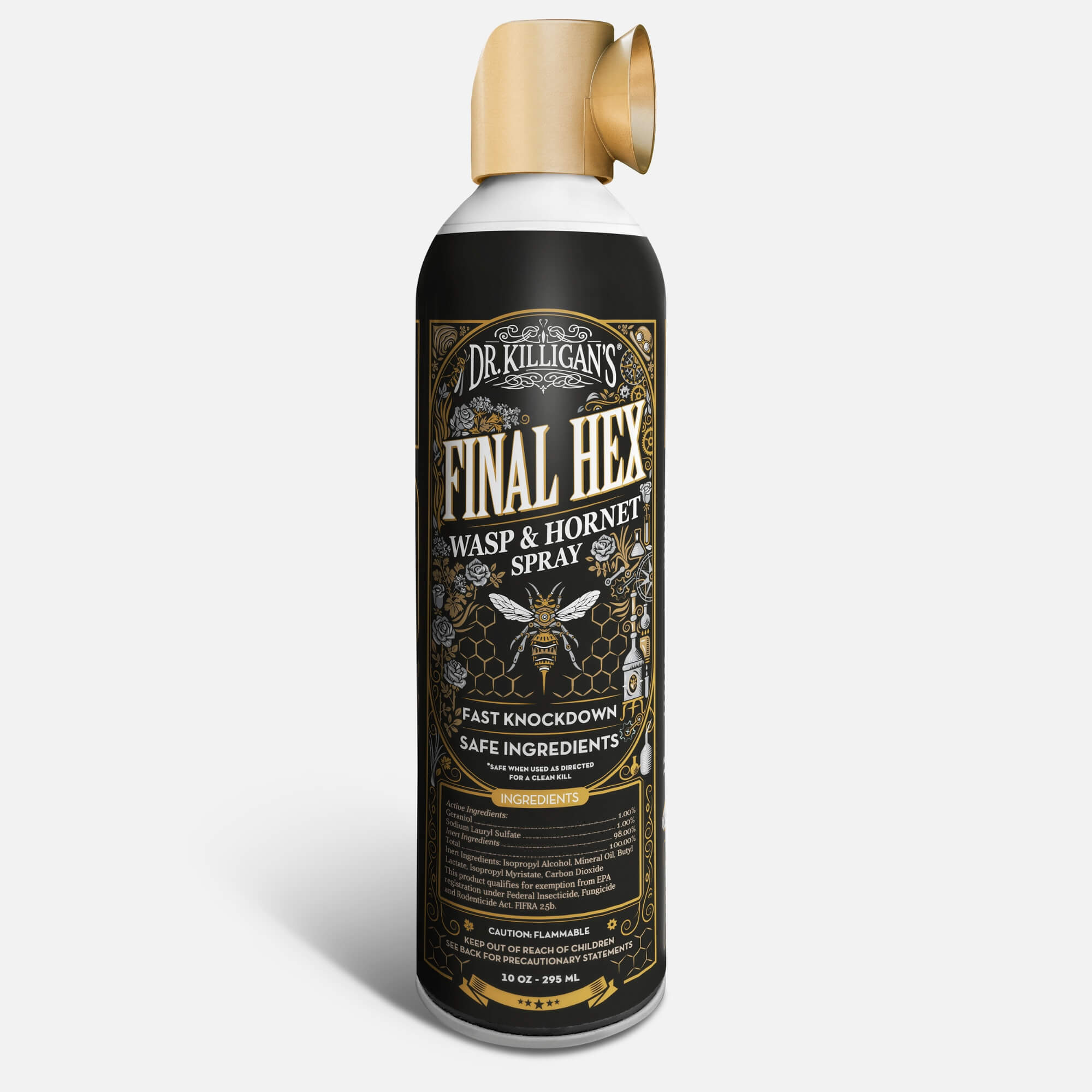
Final Hex: Wasp & Hornet Spray - Fast Knockdown - Reaches Up to 15 ft (10 oz)
Note: Anyone with a known allergy or sensitivity to stings should also avoid treating a nest themselves.
What should you do if yellowjackets are nesting inside a wall?
First, do not seal the opening while the colony is active. Blocking the exterior entrance can force yellowjackets to search for another exit, including one that leads into your home.
What you do next depends on where the nest actually is:
- If the nest itself is accessible: Treat the nest directly with Final Hex, following the label directions.
- If the nest is hidden deep inside the wall: Do not spray blindly into the opening. Hidden structural nests are difficult to reach effectively and are better handled by a pest management professional.
- If the nest is out of the way and poses little risk: In climates with freezing winters, you may be able to leave it alone until sustained cold kills the colony.
Once the colony is inactive, seal the exterior opening to close off that access point.
How to treat a ground yellowjacket nest with Final Hex

For an accessible ground yellowjacket nest, apply Final Hex before sunrise or after sunset, when stinging insects are least active. Wear gloves, protective eyewear, long sleeves and pants. Position yourself upwind before spraying, and keep children and pets away during application and until the product has dried or settled.
- Aim Final Hex directly into the nest entrance at ground level.
- Apply according to the label directions.
- Step back immediately and give the area space.
Final Hex is designed for direct nest treatment and delivers a high-output stream from a pressurized aerosol can. Its alcohol-based formula uses Geraniol Oil and Sodium Lauryl Sulfate as active ingredients and targets stinging insects including yellowjackets, paper wasps, hornets and mud daubers.
Important: Final Hex is a contact insecticide, not a residual treatment. It works when applied directly to stinging insects and nests but does not continue killing yellowjackets after the product has dried.
What should you look for after treating a yellowjacket nest?
Check the nest entrance about 24 hours after treatment. If yellowjackets are still actively entering or leaving, the nest should still be treated as active. Final Hex can be reapplied as needed and larger or more established nests may require additional treatment.
Only consider removing an accessible nest once there is no visible insect activity. Even then, wear protective clothing and approach during a lower-activity part of the day.
This is also the time to repair gaps or openings that may have provided access around the home. For ground nests, leave the area undisturbed until you are confident activity has stopped.
Explore more
- Honey bee vs. yellowjacket: Which buzzes by you? A closer look at how to tell yellowjackets from honey bees by appearance, behavior and nesting habits.
- Why do wasps get aggressive? Why wasp behavior can change as colonies grow and seasonal food sources shift.
- How to get rid of wasps: A broader guide to identifying wasp activity, locating nests and choosing a treatment approach.
- How to get rid of wasps with diatomaceous earth How diatomaceous earth can fit into a different approach to wasp and yellowjacket control.
- How to get rid of yellowjackets, step by step A quick checklist for finding a ground nest and treating it at the entrance.