
By Harrison Lowell, Guest Author
Open a drawer of cedar you bought last year and you may smell nothing. Cedar's scent comes from natural oils in the wood, and those fade over time. What a cedar product does about that — how it's stored, and whether it can be refreshed — matters as much as the wood itself. Here's how Dr. Killigan's Cedar Chips Canister compares with a budget block pack, and with a "cedar-scented" product that isn't cedar at all.
At a glance
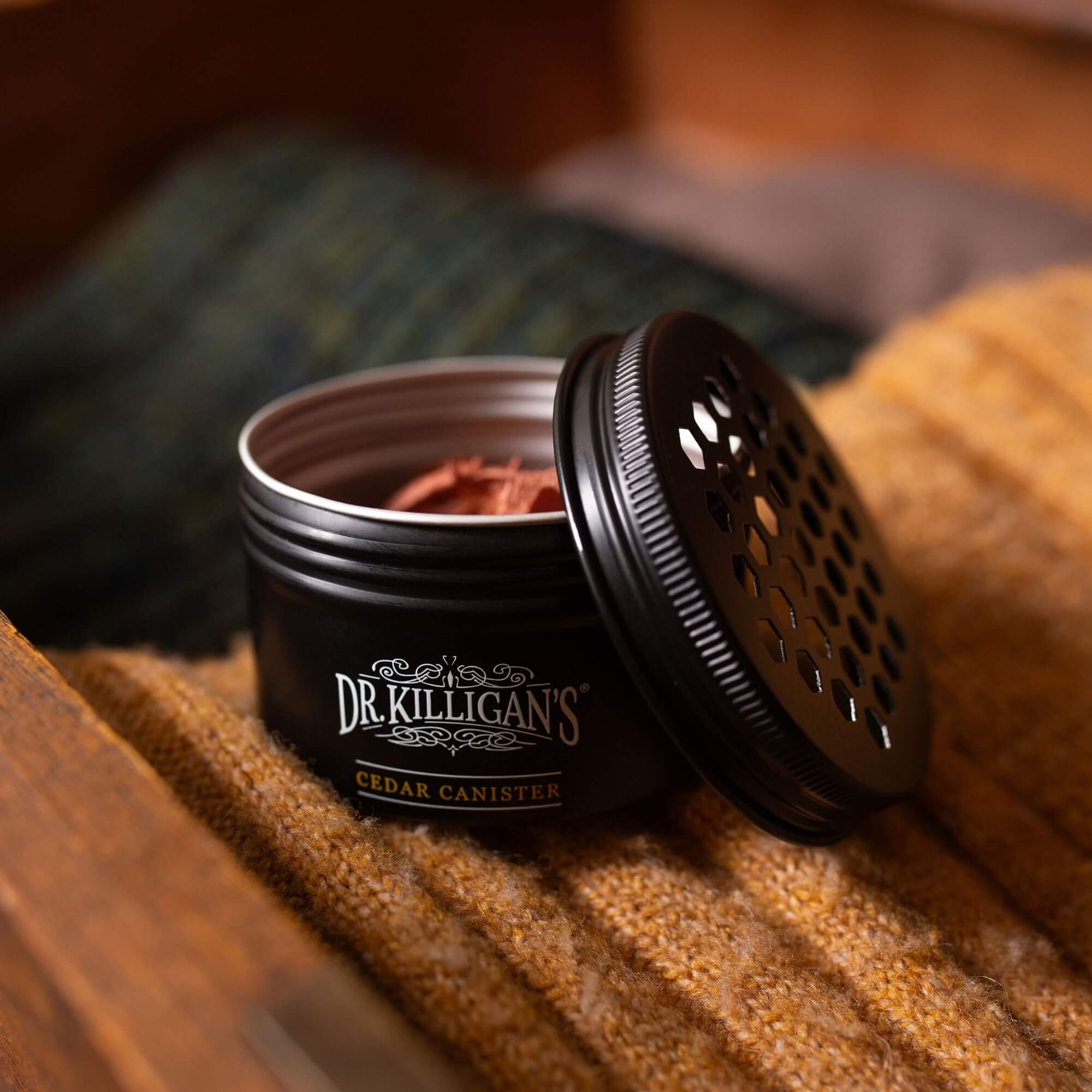
| Cedar Chips Canister (Dr. Killigan's) | Cedar Space 16-pack | Enoz Cedar Moth Bar | |
|---|---|---|---|
| Price | $24.97 / 8 canisters ($3.12/canister) | $11.19 / 16 blocks ($0.70/block) | $22.31 / 3 bars ($7.44/bar) |
| Format | Reusable aluminum tins, sealed until first use | Solid cedar blocks | Hanging solid bar |
| Repellent ingredient | Cedarwood oil, from Eastern red cedar chips | Cedarwood oil, from "aromatic red cedar" (species not named) | Paradichlorobenzene 99.68% (EPA Reg. No. 1475-113) |
| Refresh | Cedar Ward spray | Light sanding (per listing) | None — the bar turns to vapor until it’s gone, then you buy a new one |
| Rating | 4.7★ | 4.2★ | 4.1★ |
Prices and ratings were checked in October 2026 — ours on drkilligans.com, Cedar Space's on Amazon, where the 16-pack carries 4.2★ across 13,288 ratings, and Enoz's at Walmart, where the 3-pack carries 4.1★ across 70 ratings. Our own price is list price and may be lower during a sale — check the current listing.
What makes cedar work in a closet
Cedar's smell comes from cedarwood oil, and that oil is also what repels moths. Where real-cedar products differ is how you get that oil back once it fades. Cedar Space's listing says to lightly sand its blocks, which scrapes away the dried surface to expose fresh wood underneath. Dr. Killigan's chips are refreshed with Cedar Ward, a cedarwood oil spray that puts oil back instead, and they arrive in aluminum tins sealed until first use, so they haven't been exposed to air before you open them.
Cedar-scented isn't cedar
Not everything sold next to cedar contains cedar at all. Enoz's Cedar Moth Bar is paradichlorobenzene 99.68% (EPA Reg. No. 1475-113), a registered chemical fumigant scented to smell like cedar. It works on a different principle — a vapor that fills a closed space — so it belongs in a different comparison: see Clothing Moth Traps vs. Mothballs.
The honest trade-off
Cedar only works while its oil does. As the oil evaporates, the repellency fades along with the scent, so any cedar — blocks, planks or chips — stops protecting a closet unless you refresh it. And even fresh cedar repels rather than kills: it won’t stop larvae already in a sweater, so an active infestation calls for pheromone traps alongside it.
Price, honestly
Cedar Space's 16-pack works out to $0.70 a block against our $3.12 a canister — less than a quarter of the per-piece price. If the lowest price per piece is the deciding factor, solid blocks are the honest answer. What the difference buys is chips you refresh with Cedar Ward (sold separately) instead of with sandpaper. If you’d rather have solid wood, Dr. Killigan’s Cedar Planks are the closer match to Cedar Space’s blocks: 10 sustainably sourced planks with hangers for $24.97, or $2.50 a plank. Each plank is more than twice the size of a Cedar Space block, so you get more cedar for the money than the per-piece price suggests. The higher price also covers the hangers, and the same Cedar Ward spray extends the planks’ potency up to 10 times longer.
Why trust Dr. Killigan's: Dr. Killigan's is a pioneer in minimum-risk pest control, formulating plant-based solutions alongside a practicing entomologist. Every product is evaluated against the actual pest it's meant to kill or repel before it ships. "Natural" isn't the finish line. Proven is.
FAQ
What's the best smelling cedar for a closet?
Real aromatic red cedar, whether it comes as a block, a plank or chips. Check the label, though: a product can smell like cedar without containing any cedar at all, as the Enoz bar above shows.
Why did my cedar blocks stop smelling like anything?
The oil at the surface has evaporated, which happens faster in heat and moving air. The wood underneath still holds oil, so the scent can usually be brought back rather than replaced.
How long do cedar chips last?
Once the tin’s seal is removed, the chips stay effective for up to 6 months. Refreshing them with Cedar Ward every 1–3 months restores their oil and keeps them working.
Bottom line
Both are real cedar, and both fade. Blocks cost less per piece, but keeping them working means sanding each one by hand. The canister arrives sealed and comes back with a quick spray, and it’s backed by our 100% satisfaction guarantee. If you want cedar that’s simple to keep working, that’s the one to buy.
Related reading
- Cedar Planks That Actually Smell Good — and Keep Working
- Clothing Moth Traps vs. Mothballs
- Pantry Moth Traps Compared: What Lure Strength Actually Changes
Featured in this article
Shop Dr. Killigan's Essentials

Cedar Chips Canister (8 Pack) - Premium Pest Repellent: 100% Natural Protection

Cedar Ward - Rejuvenating Spray - Premium Cedar Oil - Restore The Natural Preventative Properties of Cedarwood (4 oz)