
By Harrison Lowell, Guest Author
Diatomaceous earth works. That isn't in dispute, and any comparison that opens by telling you otherwise is selling you something. DE has been drying insects out for decades, and it doesn't break down the way a spray residue does.
The honest question isn't whether DE works. It's what's actually doing the killing — because that's where these two part company, and everything else here follows from it: the actives on each label, how each is regulated, and what you pay.
At a glance
| Dust to Dust (Dr. Killigan's) | Safer Home DE Ant & Crawling Insect Killer | |
|---|---|---|
| Price | $17.97 / 10 oz ($1.80/oz) | $15.97 / 64 oz ($0.25/oz) |
| Active ingredients | Peppermint oil 3.00%, rosemary oil 3.00% (6.00% actives)* | Silicon dioxide from diatomaceous earth 85.00% |
| How it kills | Plant-oil actives | Desiccant mineral |
| Regulatory status | Exempt from EPA registration under FIFRA 25(b) | EPA-registered pesticide, Reg. No. 50932-12-42697 |
| Rating | 4.8★ | 4.1★ |
*Silica and stearic acid are listed as inactive ingredients. Prices and ratings were checked in August 2026 — ours on drkilligans.com, Safer Home's at Home Depot, where it carries 1,370 reviews. Competitor pricing varies by retailer and size; check the current listing.
What's actually in each
Diatomaceous earth is fossilised algae, ground fine. Safer Home's registered version is 85% silicon dioxide from diatomaceous earth; other registered DE products vary. (You'll also see food-grade DE sold at 100%, but that's a feed additive, not an EPA-registered insect product. Worth knowing which one you're holding.) It kills by abrasion and desiccation: the microscopic particles compromise an insect's waxy outer layer and it dries out.
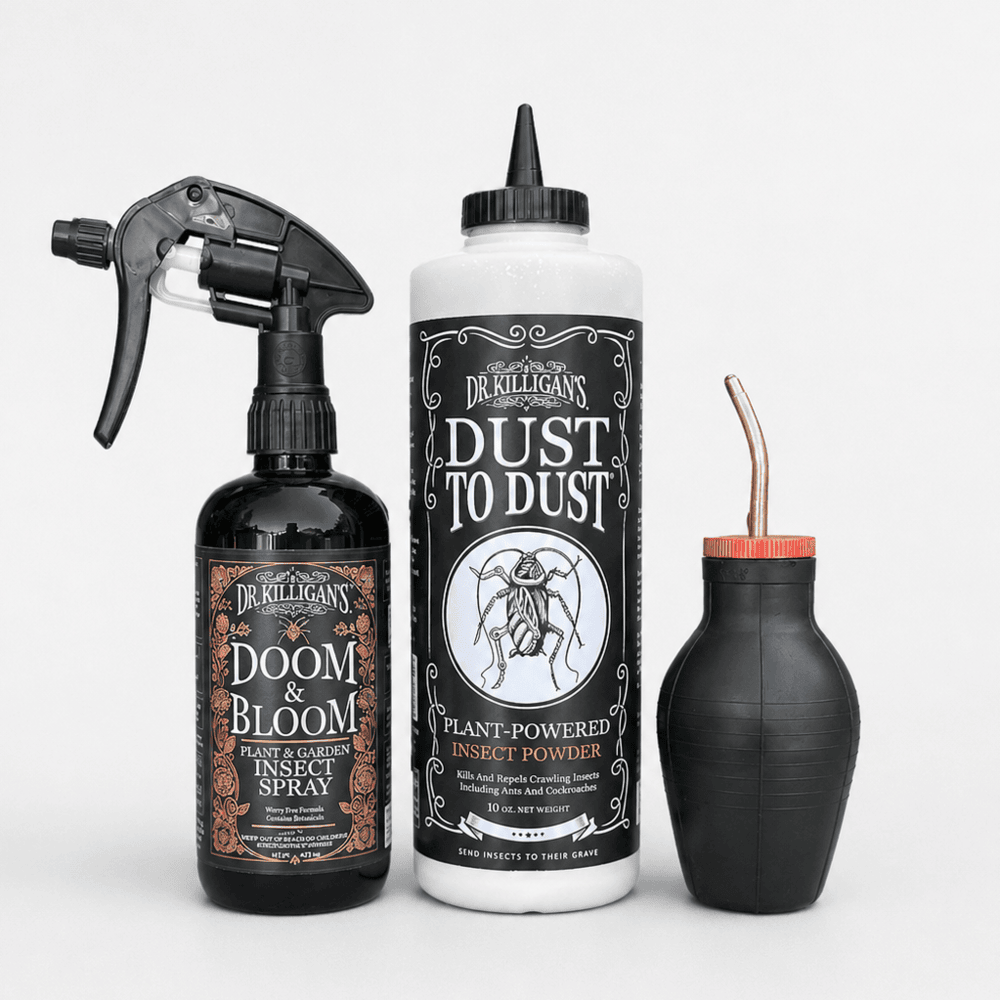
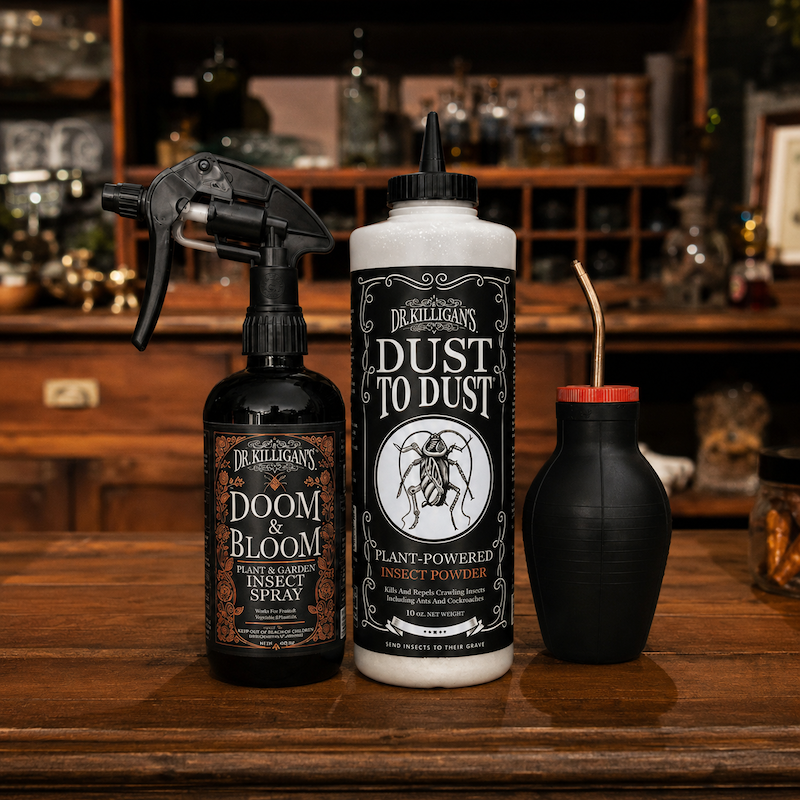
Dust to Dust is a powder built around essential oil actives. Peppermint oil and rosemary oil make up 6.00% of the formula — 3.00% each. Those two are what the label registers as the actives.
This is the part most comparisons get wrong in both directions. Dust to Dust isn't a mineral-free alternative to DE, and it isn't DE with a scent added. What it registers as its actives are two plant oils; what Safer Home registers is a mineral.
The honest trade-off
The difference that matters most: DE insect killers are EPA-registered pesticides. Dust to Dust qualifies for exemption from EPA registration under FIFRA 25(b), the federal minimum-risk category. Both still carry label directions, and both should be used according to them.
Price, honestly
DE is far cheaper per ounce, and it isn't close. Safer Home's 4 lb bag works out to about a seventh of Dust to Dust's per-ounce price. If you're treating a large perimeter, a crawlspace or an outbuilding, that math is hard to argue with, and this page isn't going to pretend otherwise.
What you're paying for with Dust to Dust is the formulation — plant-oil actives rather than a straight mineral, and a minimum-risk exemption rather than a pesticide registration. Whether that's worth seven times the per-ounce price is a judgment about your household, not a spec.
A note on dust, for pet owners
This applies to every powder in this category, ours included. EPA-registered DE labels carry a precautionary statement under Hazards to Humans and Domestic Animals directing users to use adequate ventilation, avoid breathing the dust, and wear a NIOSH/MSHA-approved dust mask during prolonged application. Sensible practice with any fine powder: apply in thin layers into cracks, voids and baseboards rather than broadcasting it across open floor, and let it settle before pets return to the area.
Why trust Dr. Killigan's: Dr. Killigan's is a pioneer in minimum-risk pest control, formulating plant-based solutions alongside a chemist. Every formula — including Dust to Dust — is evaluated against the actual pest it's meant to kill before it ships. "Natural" isn't the finish line. Proven is.
FAQ
Is Dust to Dust diatomaceous earth?
Not the same product. Safer Home's active is silicon dioxide from diatomaceous earth. Dust to Dust's actives are peppermint oil and rosemary oil at 3.00% each.
Is Terro's ant dust diatomaceous earth?
No. Despite the name and the shelf placement, Terro Insect Control Dust (T600) is a synthetic deltamethrin product at 0.05%, EPA Reg. No. 149-12, on a limestone carrier. If you were assuming every powder in that aisle was mineral-based, it isn't.
Does a powder work better than a spray?
They do different jobs. A powder placed in a crack, void or baseboard keeps working long after a spray residue has broken down. For an infestation you need knocked down immediately, a direct-contact spray is faster. Many people use both.
Will it keep working after it's applied?
Yes, as long as it stays dry, which is true of any powder application. Moisture is what ends the useful life of a dust application — reapply after cleaning or a spill, and follow the label directions for the area you're treating.
Bottom line
Cost or chemistry — that's the whole decision. Plain DE if the per-ounce price is what matters and a registered mineral is what you want. Dust to Dust if you'd rather the actives be plant oils under a minimum-risk exemption.
Related reading
- Natural Alternatives to Raid That Actually Work
- A Natural Garden Bug Spray If You Actually Eat What You Grow
- Dr. Killigan's vs. Pestie: Which Whole-Home Barrier Actually Lasts 90 Days?
Featured in this article
Shop Dr. Killigan's Essentials

Dust to Dust: Dual-Action Kills & Repels - Plant-Powered Insect Powder (10 oz)

Six Feet Under: Indoor & Outdoor Insect Killer & Repellant - Fast-Acting (24 oz)