By Harrison Lowell, Guest Author
Aphids showed up on the tomatoes you've been babying since April and the fastest fix at the hardware store is a bottle of Sevin, which also comes with a label telling you how many days to wait before you can harvest and eat what you just sprayed. If you'd rather not do that math every time bugs show up, here's how Doom and Bloom compares with the garden-spray aisle.
At a glance
| Doom and Bloom (Dr. Killigan's) | Sevin Insect Killer | Bonide Captain Jack's Neem Oil | |
|---|---|---|---|
| Price | $16.97 / 16 oz ready-to-use ($1.06/oz) | $17.97 / 32 oz concentrate ($0.56/oz) | $11.97 / 32 oz ready-to-use ($0.37/oz) |
| Active ingredient | Soybean oil 2.25% (mechanical kill) | Zeta-cypermethrin 0.35% (synthetic pyrethroid) | Clarified neem oil extract 0.90% (ready-to-use) |
| Regulatory status | Exempt from EPA registration under FIFRA 25(b) | EPA-registered pesticide, Reg. No. 279-3347-71004 | EPA-registered pesticide, Reg. No. 70051-13-4 |
| Rating | 4.8★ | 4.0★ | 4.0★ |
| Wait time before harvest | None required | 1 day for most vegetables (21 for dried legumes) | None required |
Prices and ratings were checked in August 2026 on each brand's own product page, or at Home Depot for products the brand doesn't sell direct. Our own prices are list price and may be lower during a sale — check the current listing.
What's actually in the garden-spray aisle
Sevin, Ortho BugClear and Spectracide Triazicide, three of the most common garden sprays, are synthetic insecticides. Sevin deserves a closer look than most people give it: it was a carbaryl product for decades, but the brand was reformulated, and the Insect Killer Concentrate on shelves now is zeta-cypermethrin 0.35% — a synthetic pyrethroid, not the carbamate you may remember. Ortho BugClear uses bifenthrin and zeta-cypermethrin; Spectracide Triazicide uses gamma-cyhalothrin. They kill a broad range of pests fast and carry pre-harvest interval instructions on the label for exactly that reason: they're doing real chemical work on a plant you're going to eat.
Doom and Bloom works differently. Its active is soybean oil, which kills soft-bodied pests like aphids and mites mechanically (by coating and suffocating them) rather than chemically. It sits in the same category as neem oil and insecticidal soap, the two most established plant-oil options for spraying close to harvest. Bonide's Captain Jack's Neem Oil alone carries thousands of reviews across the major garden retailers, which tells you how mainstream that category already is.
The honest trade-off
Neem oil and soybean oil sprays need more frequent reapplication than synthetic residual insecticides. That's the real trade for not putting a pre-harvest wait on your tomatoes. If you're managing an active infestation of something like Japanese beetles, a synthetic option may knock it down faster.
Price, honestly
Doom and Bloom costs more per ounce than both the synthetic sprays and the market-leading neem oil options — and it's a newer entrant in a category Bonide has dominated for years. Bonide's ready-to-use neem oil works out to roughly a third of the cost per ounce. Sevin looks cheaper still, but that's not a like-for-like number: its 32 oz bottle is a concentrate you dilute, so a single bottle makes far more finished spray than a ready-to-use bottle of the same size. The case for paying more isn't that it kills more. It's what you don't have to do afterwards.
Why trust Dr. Killigan's: Dr. Killigan's is a pioneer in minimum-risk pest control, formulating plant-based solutions alongside a practicing entomologist. Every formula, including Doom and Bloom, is evaluated against the actual pest it's meant to kill before it ships. "Natural" isn't the finish line. Proven is.
FAQ
Is there a natural alternative to Sevin that actually works?
Yes, for what most home gardeners are actually fighting — aphids, mites, thrips. Those are soft-bodied, and an oil that coats and suffocates handles them well. Beetles are a different problem, and the answer changes.
Do I have to wait before I can eat what I sprayed?
No — there's no interval on the label to track. Rinse produce as you normally would and pick when you're ready.
Will it hurt bees or other beneficial insects?
Doom & Bloom works by contact, like neem oil, so it only affects insects it touches directly. Spray just the pest itself, and avoid open blooms when pollinators are active.
Is this the same as neem oil?
No — Doom and Bloom's active is soybean oil, not neem. They behave similarly in the garden; the difference is which oil is doing the work.
Bottom line
The question isn't really which spray is stronger. It's whether the thing you're spraying is something you plan to eat — because that's what decides whether a label's fine print matters to you at all.
Related reading
- Is There a Natural Wasp Spray That Works as Fast as Raid?
- Dust to Dust vs. Diatomaceous Earth: What's Actually Doing the Killing?
- Natural Alternatives to Raid That Actually Work
- Soybean oil's secret to stopping bugs: 6 ways it works wonders
Featured in this article
Shop Dr. Killigan's Essentials

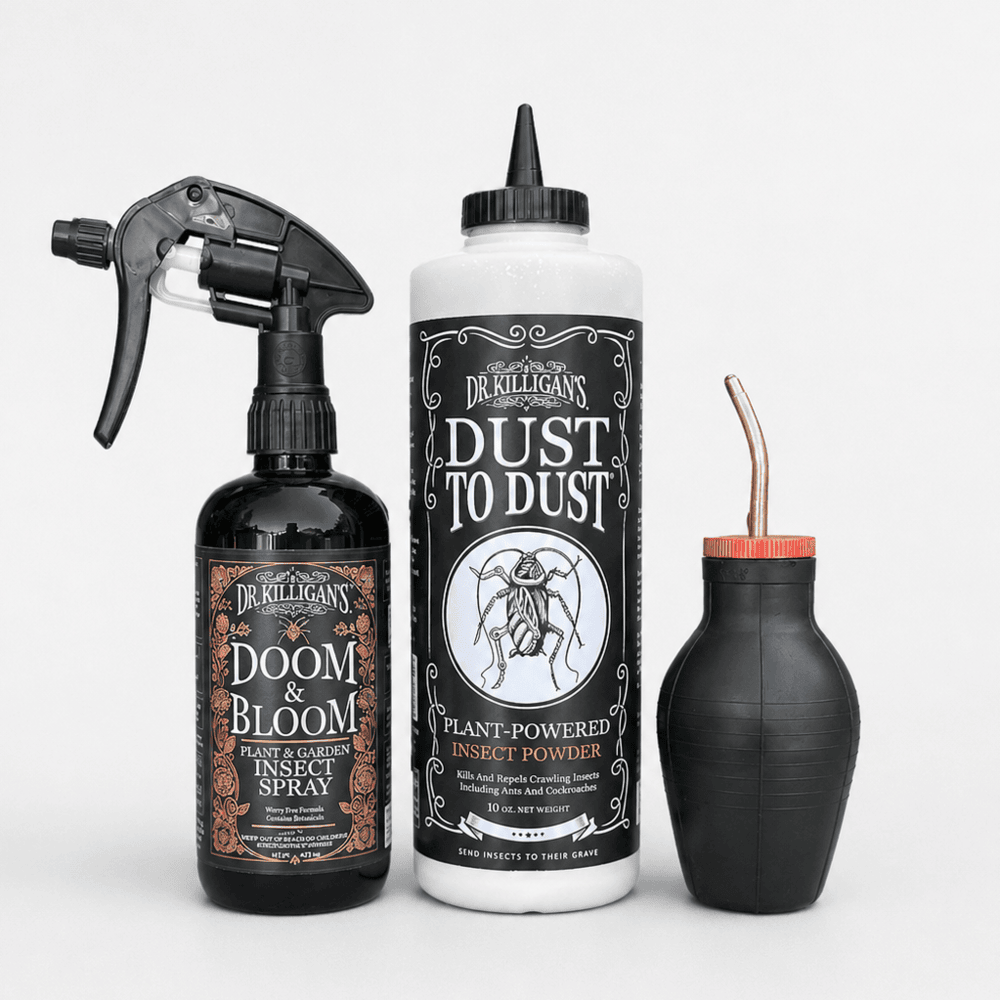
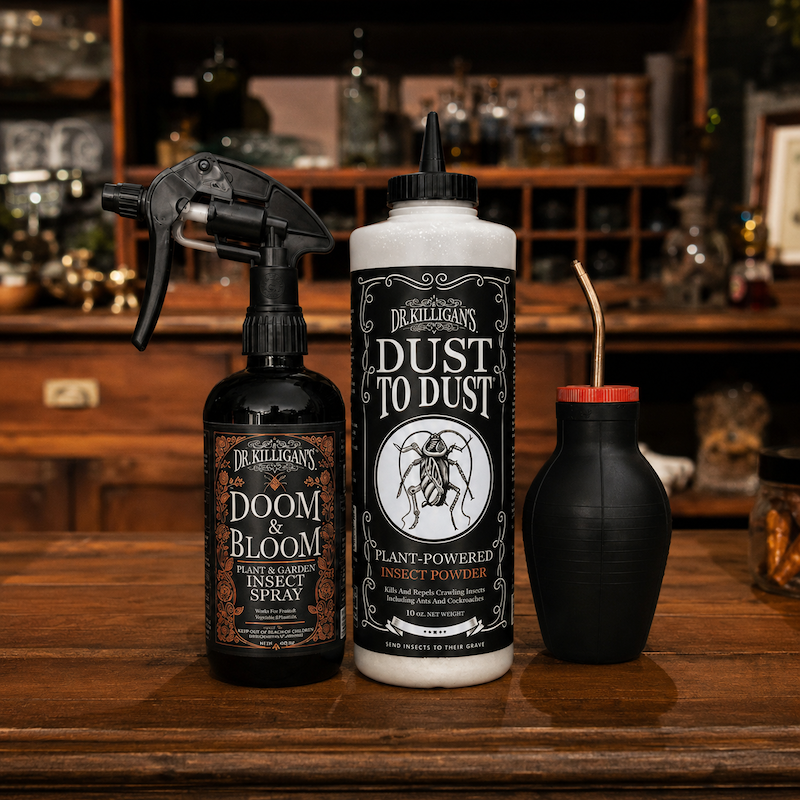
Doom and Bloom: Plant & Garden Insect Spray - Fast-Acting - Safe Around Pets & Family (16 oz)

Dust to Dust: Dual-Action Kills & Repels - Plant-Powered Insect Powder (10 oz)