

Published June 8, 2023 • Updated July 31, 2026
Reviewed by Julie Miller, BA in Language Arts, Editorial Lead, Dr. Killigan’s
TL;DR: Most nighttime insect sounds are harmless and come from outside—usually crickets, katydids or cicadas creating chirps, rasps and steady buzzing from the grass and trees. Inside, the most common culprits are a stray cricket or a mosquito buzzing near your ear, while true scratching or scurrying in walls is almost always caused by rodents or other small animals, not insects.
At night, when the house finally settles and the lights go out, even small sounds feel louder. A sudden chirp, a steady buzz or a sharp click can make you stop and wonder: What’s out there? And is it normal?
A few recognizable patterns can help you identify what you’re hearing and determine whether it’s coming from your yard, your porch light or inside your home.
Most nighttime insect sounds are harmless
The reassuring truth is that most insect noises are simply forms of communication, not warning signs of an infestation. Once you know who’s “speaking” and what their calls mean, those mysterious nighttime sounds become much easier to interpret.
How to identify nighttime insect sounds (quick guide)
Here’s a fast sound map you can refer back to when you’re trying to decode bug sounds at night.
| Sound you hear | Most likely — and how to tell |
|---|---|
| Rhythmic chirp, like a tiny violin or metronome | Cricket. Speeds up when it’s warmer; usually near the ground, foundations or gardens, and sometimes indoors. |
| Long, continuous trill | Tree cricket. Steadier and more musical than a chirp; comes from shrubs and trees and blends into the background. |
| Raspy clicks or “katy-did, katy-didn’t” | Katydid. Higher and scratchier than a cricket; comes from up in trees, shrubs and tall grass. |
| Loud, steady buzz that rises and falls | Cicada. Loudest on hot days; seems to surround you from high in the treetops. |
| High-pitched whine right by your ear | Mosquito. Gets louder as it nears your head; often followed by a bite. |
| Faint hum from a small hovering cloud | Gnats or midges. Many tiny insects together near a lamp, window or damp spot; usually no bite. |
| Soft tapping or bumping on a lampshade or ceiling | Moth (or a beetle). Follows the light; the tapping stops when you turn the light off. |
| Faint, dry, clock-like ticking from inside wood | Deathwatch or wood-boring beetle. A slow tick…pause…tick from old timber itself, not frantic—most common in spring. |
| Buzzing and bumping repeatedly against a window | House or cluster fly. Visible at the glass; most common in late summer and fall. |
| Deeper, angry buzz near an eave or the attic | Wasp or hornet. More active by day; you may see insects coming and going from one spot. |
| Faint rustling or papery skittering | Cockroaches (or ants). Scatters when you flip on a light; check for droppings. |
| Scratching, gnawing or scurrying in walls | Not an insect — rodents. Heavy, irregular movement; look for droppings or gnaw marks and call a pro. |
The main insects that make noise at night
Three groups account for almost all the sounds you hear outdoors: crickets, katydids and cicadas. Each has its own way of making sound and its own signature style.
Crickets: the classic chirpers

Cricket (Gryllus domesticus)
Crickets are the soundtrack of late summer nights. Their song comes from a process called stridulation—the male rubbing one wing’s rough, scraper-like edge against a serrated ridge on the other, using specialized “stridulatory organs” built just for making that chirp. That friction creates the familiar chirp, repeated in patterns that can change with temperature, time of night or the type of message being sent.
Why crickets make noise at night
Cricket songs are first and foremost about courtship. Males call to attract females, warn off rival males and communicate their presence in a territory. Night offers cooler air, fewer visual predators and a quieter background, so their calls carry farther and stand out more clearly.
Where you’ll hear them
- Along foundations and fences
- In lawns and gardens
- Under decks and porches
- Occasionally indoors (through gaps under doors or torn screens)
Katydids: the clicking and rasping “leaf bugs”

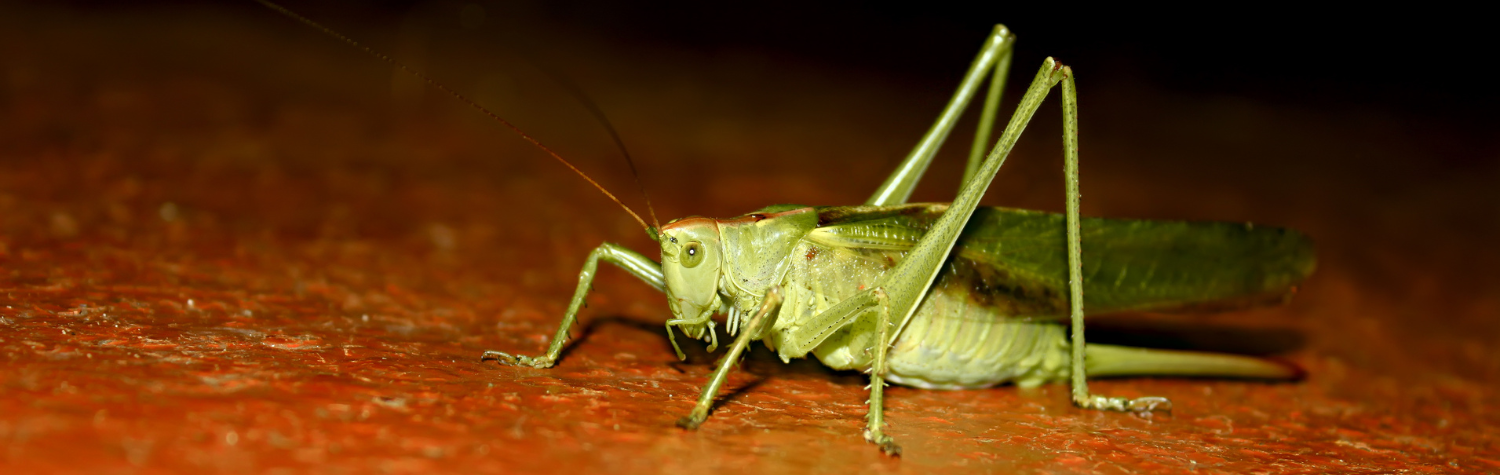
Katydid (Tettigoniidae)
Katydids are masters of disguise, often shaped and colored like leaves. Their sounds, however, are anything but subtle. Like crickets, katydids produce sound through stridulation, but their wings have specialized stridulatory veins with tiny tooth-like structures. When a katydid rubs its wings together, those teeth slide against each other in rapid motion, producing clicks, rasps or the famous “katy-did, katy-didn’t” pattern. That wing-rubbing system can create a surprising range of sounds, from soft and subtle to sharp and piercing, which is part of what makes katydid calls so distinctive.
Why katydids make noise at night
Katydid calls are complex and species-specific. Males use them to attract females during the mating season, signal their fitness and strength, establish territory and sometimes warn of danger or compete with other males. To a listening female, details in the pattern and rhythm can offer clues about the male’s health and suitability as a mate.
Where you’ll hear them
- High in trees, especially along forest edges
- Shrubs and hedges near homes
- Tall grasses in fields and overgrown lots
Their calls blend into the background for some people; for others, the rasping or clicking is one of the first signs that late summer has arrived.
Cicadas: the loud buzzers in the trees

Cicada (Cicadoidea)
Cicadas are the power vocalists of the insect world, creating some of the loudest buzzing insects at night. Their sound can be startling the first time you hear it—especially when a large group calls together. Instead of rubbing body parts together, cicadas use a pair of ribbed membranes called tymbals, located on their abdomen. When a cicada contracts its muscles, those membranes buckle in and spring back out, creating vibrations. A hollow cavity inside the body acts as a resonating chamber, channeling the vibrations from the tymbals and amplifying them like a tiny drum or speaker.
Why cicadas make noise at night
Cicadas call to attract mates (each species with its own distinct “song”), signal presence and territory, coordinate group behavior, and potentially confuse or deter predators through loud, collective choruses. Not all cicadas are strictly nighttime callers; many are most active during the day or at dusk. On very warm evenings, though, their buzz can carry well into the night.
Where you’ll hear them
- High in trees and woodlands
- Along forested streets and parks
- Around sunny, tree-filled yards
Because they call from above, cicada sounds feel like they surround you, echoing through the canopy rather than from the ground.
What insects make noise at night inside your house
Most of the nocturnal “music” you hear is outdoors. Still, when you’re dealing with insects that make noise at night in the house, there are only a few likely culprits.
Insects you might actually hear inside
- Crickets. A single house cricket trapped behind furniture or an appliance can chirp for hours. Indoors, its rhythmic call often sounds much louder because there is less background noise.
- Mosquitoes, gnats and midges. Their wingbeats create a high-pitched whine or faint hum. Mosquitoes are most noticeable near your ears, while gnats and midges tend to gather near lights, windows or damp areas.
- Occasional moths. A moth circling a lamp or ceiling fixture may make soft taps or bumps as it strikes the surface.
A few less common noisemakers are worth a mention, too: a house or cluster fly bumping against a window (our Fly Inn Traps are made for exactly that), a wasp buzzing near an eave or attic (see Final Hex Wasp & Hornet Spray) or faint, papery rustling from cockroaches behind a cabinet (Six Feet Under can help kill cockroaches on contact).
No, insects are not “scratching in your walls”

If you’re hearing scratching, gnawing, thumping or running sounds between walls or above ceilings, that’s almost certainly not insects. Rodents and other small animals have the weight and claws needed to make those noises. Insects simply don’t. The one exception is a faint, dry, clock-like ticking coming from old wood, which can be a wood-boring or deathwatch beetle—but that’s a slow, quiet tick, not the heavy scratching or scurrying of a rodent. If those louder sounds are persistent or getting louder, it’s worth speaking with a local professional who handles wildlife or rodent issues.
Are nighttime insect sounds a sign of a problem?
In most cases, no. Nighttime insect sounds are simply part of a healthy outdoor ecosystem. You may want to investigate further if the noise is clearly coming from inside your home, you’re being bitten by mosquitoes or seeing swarms indoors, or you notice signs of rodent activity in addition to sounds (droppings, gnaw marks, damaged food packaging). Otherwise, the chirps, clicks and buzzes you hear after dark are insects doing what they’ve done for thousands of years: communicating, courting and surviving.
A different way to listen: nature’s nighttime orchestra
Once you know who’s making which sound, nighttime can feel less mysterious and more like a concert: crickets keeping rhythm at ground level, katydids layering in their rasping calls from the trees and cicadas adding a rising and falling chorus from the canopy. What might have felt like random noise becomes a living pattern—messages passed back and forth in the dark.
The next warm night, if you can, step outside for a moment. Listen for the chirps, the clicks, the distant buzz. Knowing who’s “playing” each part can turn anxiety into appreciation—and remind you just how alive your yard really is, even after everyone else has gone to bed. At Dr. Killigan’s, we hope that knowing the story behind these sounds brings you a little more Confidence, Peace and Control—even after dark.
Explore More
-
Why are bugs attracted to artificial light?
(Discover why nocturnal insects are drawn to artificial light.)
-
Why am I seeing flies in my house?
(Learn how to tell cluster flies from houseflies.)
-
How to identify moths in your house
(Identify common household moths and the damage they may cause.) -
How to get rid of cockroaches
(Find signs of cockroaches and learn how to get rid of them.)