
Published June 22, 2023 • Updated May 7, 2026
Reviewed by Julie Miller, BA in Language Arts, Editorial Lead, Dr. Killigan’s
TL;DR: Pantry moth traps attract adult male food moths, including Indian meal moths, almond moths, raisin moths and Mediterranean flour moths. They work by using pheromones that mimic the scent of female moths, drawing males into the trap and interrupting the reproductive cycle.
Dr. Killigan’s Pantry Moth Traps use the Blue Stripe Formula, a double-potent moth-pheromone attractant paired with a sticky glue surface. Placed near pantry shelves, cupboards or stored dry goods, the traps help monitor and reduce pantry moth activity while you remove contaminated food and clean the source of the infestation.
What species of food moths do pantry moth traps attract?

Dr. Killigan’s Pantry Moth Traps attract several common types of food moths found in pantries and food-storage areas. These moths can contaminate stored food when eggs are laid near or on pantry goods. Once the larvae hatch, they feed on the food source, often leaving behind webbing, waste and spoiled product. Because pantry moths are known by many different names, identification can be confusing.
Here are the main pantry moth types attracted to pantry moth traps:
Indian meal moth
Scientific name: Plodia interpunctella
Also called: pantry moth, flour moth, grain moth, birdseed moth, food moth, weevil moth
Common food sources: grains, pantry staples and birdseed
Almond moth
Scientific name: Cadra cautella
Also called: tropical warehouse moth
Common food sources: stored nuts and dry pantry goods
Raisin moth
Scientific name: Cadra figulilella
Also called: dried fruit moth, food moth
Common food sources: dried fruits and similar pantry goods
Mediterranean flour moth
Scientific name: Ephestia kuehniella
Also called: mill moth, flour moth
Common food sources: grain-based pantry goods
Dr. Killigan’s approved pantry moth target list also includes food moth, grain moth, tropical warehouse moth and weevil moth.
What are Indian meal moths?

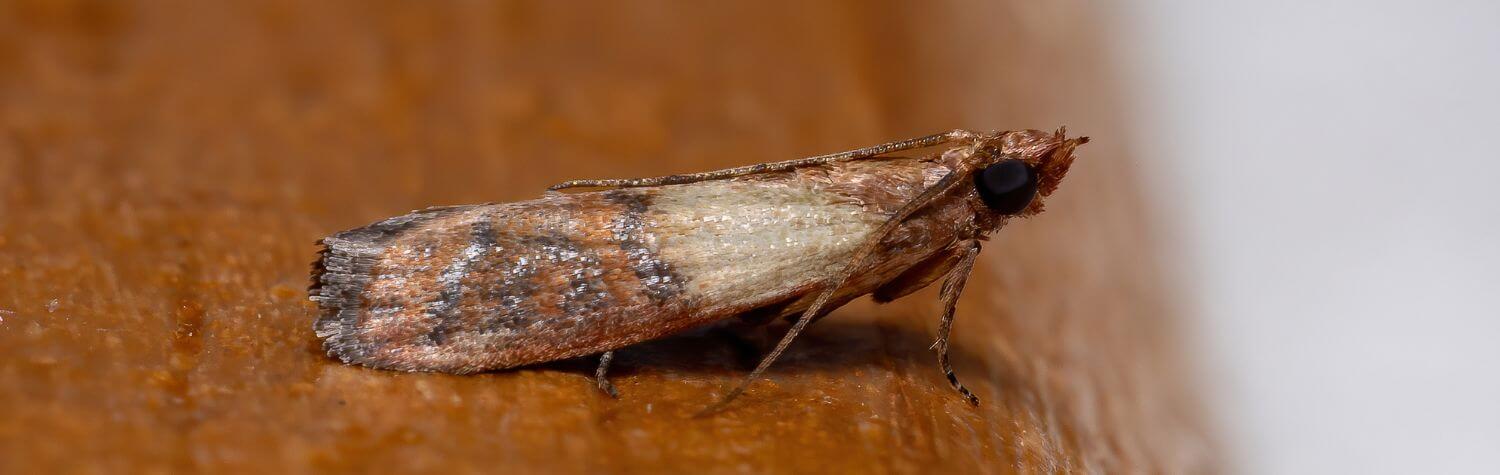
Indian meal moths (Plodia interpunctella) are one of the most common pantry moths found in homes, grocery stores and food-storage areas. They commonly infest a wide range of pantry staples, from grain-based foods to nuts, dried fruit and birdseed.
You may recognize an Indian meal moth by its small size and two-toned wings. The front portion of the wings is usually pale gray or tan, while the outer portion is reddish-brown or coppery. Adult Indian meal moths have a wingspan of about 1/2 to 5/8 inch, while their bodies are about 1/4 to 1/3 inch long. They are one of the smaller food moths you may notice near pantry shelves.
Do pantry moth traps attract Indian meal moths?
Yes. Indian meal moths are one of the primary species attracted to pantry moth pheromone traps.
What are almond moths?

Almond moths (Cadra cautella), also called tropical warehouse moths, are food moths that infest stored nuts and other dry pantry goods. As their name suggests, they are commonly found in almonds, but they may also infest walnuts, pistachios, pecans, grains, cereal and other stored foods.
Adult almond moths are small, narrow-winged moths with long, slender antennae. They are similar in size to Indian meal moths, with a wingspan of about 1/2 to 3/4 inch. Their wings are usually light brown or grayish-brown, with darker spots and markings that become more noticeable toward the outer edges. This subtle patterning can help distinguish almond moths from other small pantry moths.
Do pantry moth traps attract almond moths?
Yes. Almond moths are one of the food moth species attracted to pantry moth pheromone traps.
What are raisin moths?

Raisin moths (Cadra figulilella) are food moths that are especially drawn to dried fruit. They commonly infest raisins, dates, figs, prunes, apricots and similar pantry items.
Adult raisin moths are very small, typically about 3 to 5 millimeters long or roughly 1/10 to 1/5 of an inch. They are usually grayish-brown and more muted than many pantry moths, which can make them easy to overlook against cardboard packaging, dried fruit containers or pantry shadows. They are not especially strong fliers, so activity may appear more subtle than with Indian meal moths.
Do pantry moth traps attract raisin moths?
Yes. Raisin moths are one of the pantry moth species attracted to pantry moth pheromone traps.
What are Mediterranean flour moths?

Mediterranean flour moths (Ephestia kuehniella), also called mill moths, are pantry moths with narrower food preferences than Indian meal moths. They are especially associated with flour, cereal, pasta, bran and other milled grain products.
While Indian meal moths may infest a wider range of pantry goods—including nuts, dried fruit and birdseed—Mediterranean flour moths are more closely tied to grain-based foods.
Adult Mediterranean flour moths are usually light gray or tan, with mottled or speckled wings and fringed wing edges. They are generally larger than Indian meal moths and almond moths, with a wingspan of about 1 to 1 1/2 inches.
Do pantry moth traps attract Mediterranean flour moths?
Yes. Mediterranean flour moths are one of the food moth species attracted to pantry moth pheromone traps.
What are pantry moths attracted to?
Pantry moths are attracted to stored dry goods that give their larvae a place to feed. In the pantry, that often means flour, grains, cereal, rice, pasta, nuts, dried fruit, birdseed and similar shelf-stable foods.
A pantry moth trap uses a different kind of attraction. Instead of food, it relies on a concentrated pheromone lure that draws in adult male moths. In other words, food draws pantry moths into your pantry, while the trap draws males toward the scent of a potential mate.
Are pantry moths attracted to light?
Pantry moths may sometimes appear near lights, windows or bright areas after they begin flying through the home. Seeing moths near light can make them easier to notice, but light is not the main reason pantry moths infest a kitchen or pantry.
Pantry moths are more closely tied to stored food sources than to light. Dr. Killigan’s Premium Pantry Moth Traps do not use light as the attractant.
Do pantry moth traps attract male or female moths?
Pantry moth traps attract adult male pantry moths. They do not attract female pantry moths, eggs or larvae.
If you are still seeing moths after placing traps, the infestation source may still need to be found, cleaned or removed. Other stages of the pantry moth life cycle may also still be present.
Do pantry moth traps work for every small moth?
No. Pantry moth traps do not work for every small moth in the house. They are designed for food moths—the moths associated with stored dry goods, pantry shelves, cupboards, grains, nuts, dried fruit and birdseed.
If you see a small moth near food-storage areas, a pantry moth trap may be the right tool. If you see moths near closets, wool, silk, rugs or stored clothing, you may be dealing with clothing moths instead. Those require a different type of moth trap.
This is why proper moth identification matters.
How do I get rid of pantry food moths?

Pantry moth traps are an important tool, but they work best as part of a complete pantry cleanout. While traps help interrupt the mating cycle, you still need to remove the food sources where eggs and larvae may be hiding.
Start by finding the source of the infestation. Check the dry goods most often linked to pantry moths: flour and grains, nuts, dried fruit and birdseed. Look for webbing, larvae, clumping or small dark specks inside packages. Discard any contaminated food and seal the trash before removing it from your home.
Next, clean the affected area thoroughly. Empty the pantry or cupboard, vacuum corners and shelf seams, then wipe down shelves, walls and storage containers. Pay close attention to cracks, crevices and shelf-pin holes where debris can collect.
Once the food source has been removed and the area is clean, place Pantry Moth Traps near the area of activity. The pheromone lure helps reduce mating while you continue monitoring for signs of activity. Replace traps when full or after their effective period.
For added support, Six Feet Under® Plant-Powered Insect Spray may be used in pantry-adjacent cracks, crevices or other areas where insects may be hiding. This plant-powered spray kills pests—like moths—on contact, while also maintaining residual killing power for up to 30 days when used as directed.
For a complete step-by-step plan, read our full guide on how to get rid of pantry moths.
Explore more
-
How to get rid of and prevent pantry moths
(A step-by-step cleanout plan for removing the food source, cleaning the pantry and using traps effectively.)
-
What do pantry moths eat?
(Which pantry staples are most vulnerable to pantry moths, from grains and flour to nuts, dried fruit and birdseed.)
-
Pantry moth life cycle: Eggs, larvae, pupae and adults
(How pantry moths develop from eggs to larvae to adults—and why traps are only one part of breaking the cycle.)
-
Can pantry moths eat my clothing?
(How to tell whether the small moths in your home are food moths or fabric-damaging clothing moths.)