
Published April 6, 2026
Reviewed by Julie Miller, BA in Language Arts, Editorial Lead, Dr. Killigan’s
TL;DR: To keep bugs out of your house, build a layered perimeter routine: remove food sources and shelter, dry out damp areas, close the entry points pests rely on and apply Barricade® to establish a 90-day protective barrier around your home. Then refresh that defense as seasons shift, so small pest pressures do not become settled problems.
Bug problems don’t start inside your home. They start earlier—at the edge and often weeks before you ever see them.
Insects follow predictable seasonal patterns. Many species lay eggs in the spring and fall, timing their life cycles with temperature and moisture. Those eggs hatch in waves—often in early summer and again as conditions shift into cooler months—creating what feels like a sudden “invasion” indoors.
But it isn’t sudden. It’s a cycle. They begin outside, in the places where insects find cover, follow moisture and test for a way in. A gap under a door. Thick mulch against the foundation. A damp corner near a spigot. A bright light pulling activity toward the house.
What shows up inside is just the final step.
Perimeter start = perimeter stop. This is your opportunity to interrupt the cycle—before eggs hatch, before populations grow, before patterns repeat.
A smarter strategy is layered:
- Deter insects before they approach
- Destroy them when they attempt to enter
- Disrupt breeding cycles before they compound
When you intercept pests at the perimeter, you don’t just solve a problem—you prevent the next one. Understand the pattern. Move with purpose. Protect your space with confidence.
This guide shows you how to do that well. You will learn what draws pests closer, how to shut down easy access, how to apply perimeter protection with clarity—and why Barricade gives you a smarter, seasonally-aware defense for your home, all year long.
The best perimeter pest control routine starts with prevention
A solid routine does not begin with spraying at random. It begins with preparation.
The strongest approach uses four moves in sequence: remove what attracts pests, seal how they get in, protect the perimeter and repeat the process as conditions change.
That sequence keeps the work simple. It also keeps you from relying on one tactic to solve every problem.
1. Remove what attracts pests
Before you build protection around the house, make the area less appealing.
Pests stay where they can feed, drink and hide. Take those advantages away and you reduce the pressure before treatment even begins.
Neutralize food sources and pet stations

Bits of food support repeat activity, especially with ants, roaches, beetles and pantry pests. Start with simple habits that make the biggest difference:
- Wipe counters and tables: Remove the "scout" trails left by foraging insects.
- Decant dry goods: Move flour, cereal and pet food into gasket-sealed containers to create a biological firewall.
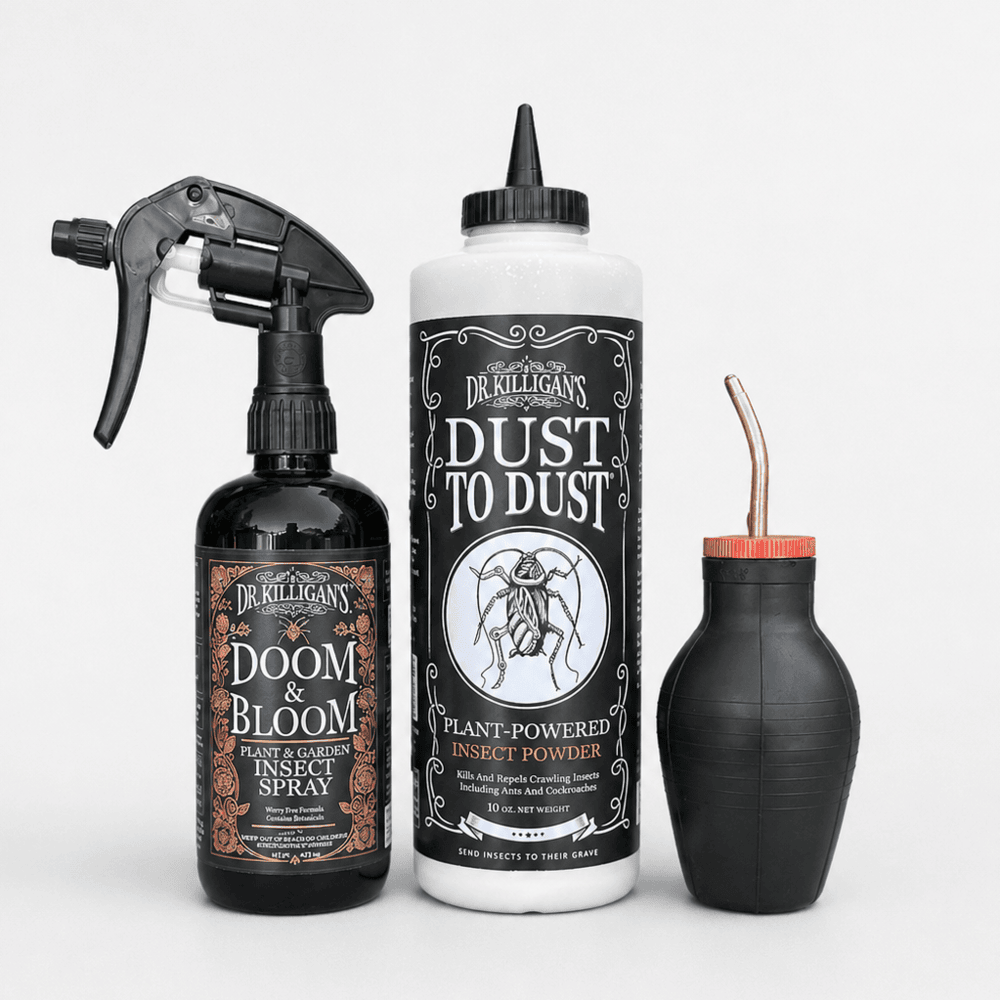
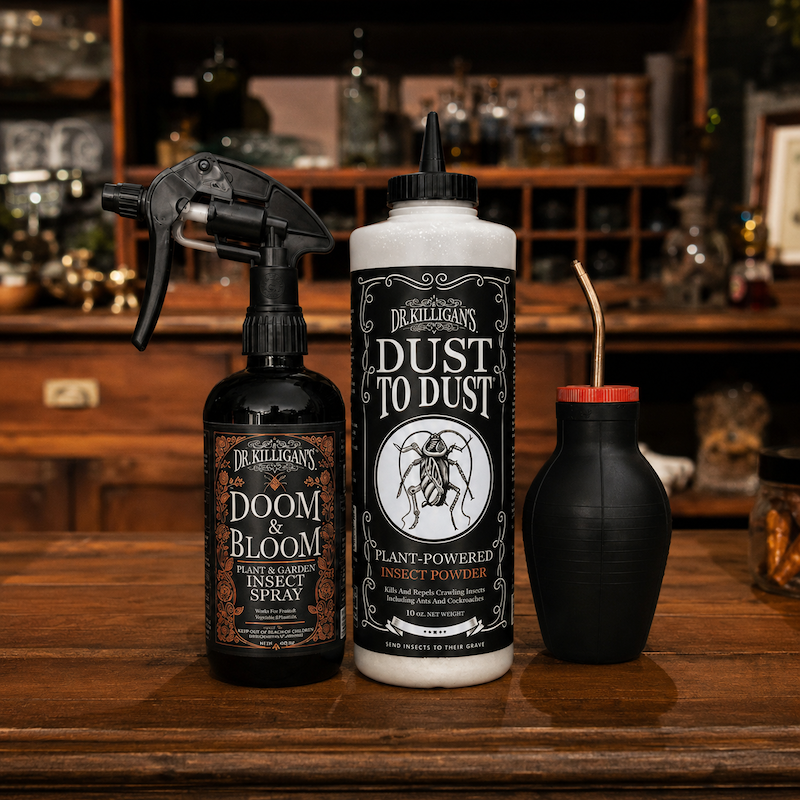
- The "Dust to Dust" pet barrier: Pet feeding areas are high-value targets. After cleaning bowls at the end of the day, apply a light perimeter of Dust to Dust® around the feeding station or beneath the storage bin. This powder creates a plant-powered barrier that stops ants and "scouts" before they can lead a trail back to the source.
Dry out moisture-prone "hot zones"
Water changes everything. Even a small damp zone can keep insect activity close to the house. Pay close attention to:
- The laundry room humidity trap: Silverfish and spiders are drawn to the damp heat behind washers and dryers. Check for slow leaks in supply lines and ensure your dryer vent is tightly sealed. For a proactive fix, spray Six Feet Under® along the baseboards and behind appliances once a month to disrupt these preferred hiding spots.
- Outdoor drainage: Clear clogged gutters, fix leaking hose bibs and address wet mulch beds.
- The foundation buffer: Dry ground and clean drainage make the perimeter of your home less useful to pests.
Fortify transition zones: Garages, attics and crawlspaces
These are the primary "portals" where outdoor pests become indoor problems.
- In the garage: Move cardboard boxes—a favorite nesting material for silverfish and crickets—onto metal shelving.
- In the attic: Clear any leaf litter or debris near soffit vents.
- Strategic application: Use Dust to Dust® in wall voids, corner junctions and around attic eaves. Because it is a silica-based powder, it remains effective indefinitely in these dry, undisturbed areas, providing a long-term "shield" where liquid sprays might evaporate.
Clear outdoor shelter and "bridge" points

Do not give pests cover right against the house. An open perimeter is easier to inspect, easier to treat and harder for pests to navigate.
- Cut back or move: Shrubs and ground cover pressed against the foundation, vines climbing the siding and branches touching the roof or windows.
- Manage debris: Move wood piles and stacked debris at least 20 feet away from the structure of the home.
- The 12-inch "No-man's land": By keeping a clear 12-inch buffer of gravel or bare dirt between your landscaping and the foundation, you drastically reduce the chance of a successful breach.
Expert insight: You do not need perfection; you need consistency. These simple shifts in your home's environment turn a "vulnerable target" into a "hardened structure."
2. Close the easiest "portals"
Once you reduce the draw, take a few minutes to claim the strategic advantage. Insects are opportunists; they aren't looking for a structural flaw, they are looking for an open door. By closing the easiest paths inside, you aren't just doing maintenance—you are outsmarting the pressure and forcing pests to interact with your Barricade boundary.
These high-impact moves take only a few minutes but provide a major victory for your home’s defense:
- The "light test" for doors: Stand inside your garage or entry door during the day. If you can see sunlight peeking through the bottom or sides, a bug can walk right in. Replacing a worn door sweep with a high-density brush seal or a low-profile silicone gasket creates an immediate, discrete and physical block.
- Quick gap fillers: For small openings around window frames or utility pipes, a bead of paintable silicone caulk or copper mesh tucked into the space acts as an immediate and invisible "no-entry" sign.
- Screen integrity: A tiny tear in a window or vent screen is a private entrance for flies and beetles. Replacing damaged mesh with high-visibility insect screening to maintain both a clear view and a total barrier.
- The garage door threshold: If your garage door seal is no longer flush with the ground, a reinforced rubber threshold can be applied to the floor. This creates a professional, weather-tight seal that closes the ground-level gap.
3. Protect the perimeter around your house

Now turn prevention into protection.
Perimeter treatment works best when you treat the outside of your home as an invisible border, not a vague area to spray and hope for the best. The goal is to create an active inclusion zone—a defined, plant-powered defensive line where insect pressure builds before it pushes indoors.
Establish your 90-day barrier. Secure your inclusion zone and intercept pests before they reach your threshold.
By establishing this zone, you aren't just wetting the pavement; you are neutralizing the primary transit system for pests. When insects try to cross this line, Barricade’s dual-action technology goes to work.
Featured in this article
Shop Dr. Killigan's Essentials


Where to focus your defense
To build your barrier with confidence, apply a steady, even spray pattern in a 3-foot band around the entire foundation. Pay extra attention to:
- Transition points: Window and door frames, utility openings and foundation cracks.
- Gathering spots: Patios, decks, garage thresholds and crawl space vents.
- Landscaped edges: The "green line" where mulch or gardens meet your home’s structure.
Pro tip: One 6oz bottle of Barricade concentrate (mixed with filtered water in our specialized application bag) makes 1 gallon of finished treatment. This is the perfect amount to create a full perimeter for a standard home up to 2,500 square feet.
A plant-powered perimeter defense
Barricade is a FIFRA 25(b) Minimum Risk pest control product. Formulated with ingredients the U.S. EPA determines pose little to no risk to the environment, it is a professional-grade shield that is not harmful to your pets or loved ones when used as directed.
The active powerhouse:
- Peppermint oil: Interrupts insect sensory receptors to erase the invisible "GPS" that ants and roaches use to navigate.
- Soybean oil: Works with residual silicates to physically disrupt insect vitals.
- Sodium lauryl sulfate: A plant-derived surfactant that ensures the formula "grips" the surface for a long-lasting barrier.
The "mechanical-kill" advantage
Conventional sprays rely on nerve toxins that bugs are learning to ignore. Barricade utilizes a physical, mechanical-kill approach that changes the rules of engagement.

- Scrambled technology: By wiping out pheromone trails, Barricade leaves pests disoriented. They can't follow their own "scent maps" into your home.
- Physical knockdown: Because the formula breaks down the exoskeleton on contact, it provides a functional kill without the use of traditional neurotoxins.
- Adaptation-proof: Since this is a physical kill rather than a chemical one, pests cannot adapt or evolve resistance over time.
Did you know? Most crawling insects are "edge-dwellers." They don't naturally seek out the middle of a room; they navigate using the vertical and horizontal intersections of your home’s exterior. By treating the active inclusion zone, you are placing your defense exactly where 90% of insect activity occurs.
4. Repeat the routine as conditions change
The best routine is the one you can return to without overthinking it.
Because Barricade lasts up to 90 days, it fits naturally into a seasonal schedule. That gives your household a rhythm you can maintain without turning pest control into a constant project. This is why many households use a quarterly subscription—it ensures the next treatment arrives exactly when the 90-day barrier needs a refresh.
A practical cycle looks like this:
Early spring
Early spring is your 'clean slate' moment. Before the ground warms fully and scouts begin their search, apply Barricade to the dormant foundation. This ensures your barrier is set before the first ant trail is even conceived or emerging spiders begin establishing webs along your home’s exterior.
Midsummer
Check the areas where bug activity tends to build and refresh the perimeter for the season. Heat, fast plant growth and shifting moisture can create new shelter and reopen familiar trouble spots near the foundation, entry points and landscaped areas.
Early fall
Reinforce the perimeter before temperatures shift and pest movement changes. As conditions cool, insects often push closer to the home looking for shelter, which makes this an important time to tighten up the outer edge.
That is how you protect your home with more confidence and less disruption. That is how you restore Confidence, Peace and Control.
What pests can perimeter pest control help with?
Barricade is engineered to intercept walking and crawling insects—the primary "infiltrators" that travel along foundations and exploit small gaps to enter your home.
By addressing the core behavior of these pests—specifically their tendency to follow moisture, seek shelter along foundations and navigate using the "edges" of your home—Barricade provides one comprehensive routine that manages multiple seasonal threats simultaneously.
The target spectrum

Barricade is effective against over 50+ insect types, categorized by how they typically test your home’s threshold:
- Common home invaders: Ants, cockroaches, silverfish and crickets
- Structural & seasonal pests: Boxelder bugs, stink bugs, beetles and earwigs
- Micro-invasives: Mites, springtails and clover mites
- Occasional & exterior pests: Grubs, weevils, pillbugs and certain species of flies
Want the full list? For a complete breakdown of all target species and specific application strategies, please see the Barricade user guide.
Common perimeter pest control mistakes
Most setbacks aren't a result of a lack of effort; they happen when a strategic gap allows the pattern to reset. To maintain your home's peace, avoid these common oversights:
- Waiting for the "invasion": If you wait to act until pests have settled indoors, you are fighting a defensive battle. The confident homeowner treats the perimeter while the house is still quiet, stopping the momentum before it builds.
- Focusing from the inside out: While interior cleanliness is vital, focusing solely on the kitchen or bathroom is like bailing water without plugging the leak. True control begins at the threshold.
- Allowing the rhythm to break: Environmental factors like heavy rain or rising heat naturally wear down any barrier. Letting your 90-day refresh slip reopens the door for scouting insects to test your foundation. Mark your calendar—consistency is your strongest defense.
- Treating over the clutter: Applying product to wet leaves, thick mulch or stacked debris is a waste of your resources. A clear, visible perimeter ensures your treatment reaches the surfaces that actually matter.
- Seeking the "silver bullet": Real control comes from the system—removing attractants, sealing gaps and applying protection. Skipping to the final step without the first two is like building a wall but leaving the gate wide open.
The Barricade promise: Year-round peace of mind
Building a perimeter isn't a one-time event; it’s a seasonal rhythm. With a quarterly subscription, you get a full year of protection delivered straight to your door exactly when it’s time to refresh your barrier.
We stand behind our formula with a bug-free guarantee. If pests return after you've applied Barricade, we will replace your treatment or refund your money. It’s that simple.
Protect the perimeter. Protect your peace.

You do not need to feel outmatched in your own home.
You can learn the pattern. You can act early. You can protect the places pests test first and keep small problems from becoming settled ones. Start by removing what pulls them closer. Close the access points they rely on. Strengthen the outer edge with a clear routine.
Then put Barricade to work.
If you want help along your pest-free journey, contact our Customer Experience team. We are here to help you protect your home wisely and well.
Beyond the foundation: Specialized Barricade applications
While Barricade is engineered as a primary foundation barrier, its mechanical-kill technology and plant-powered formula make it an ideal solution for high-traffic "micro-climates" around your property. Use these strategic applications to secure the secondary transition zones of your home.
Prevent carpenter ant damage: Decks and patios are primary targets for wood-destroying insects like carpenter ants, which exploit moisture and structural wood to expand their colonies. Apply Barricade along the perimeter of your deck, the base of patio walls and the lower structural joists. This creates a residual barrier on their "highways" to intercept scouts before they can establish a nesting site.
Neutralize "hitchhiking" silverfish and beetles: Outdoor cushions and upholstered furniture provide the damp, undisturbed shelter that silverfish and carpet beetles crave. To protect your investment, remove the cushions and flip your chairs and tables over to spray the undersides, leg joints and interior frames. This "Flip and Spray" method creates a residual barrier that neutralizes these pests before they can hitchhike from your patio into your interior living spaces.
Eliminate earwig and mite gatherings: Ornamental planters, heavy mulch beds and outdoor rugs create the damp "micro-climates" that earwigs and clover mites thrive in. To stop these moisture-seekers from congregating, apply a focused perimeter of Barricade around the base of your decorative pots and the edges of your outdoor rugs. This creates an impenetrable boundary that prevents these high-volume "invaders" from using your landscaping as a staging ground to enter your home.
Intercept mulch-dwelling roaches: Damp mulch beds and the shaded soil beneath ornamental shrubs are primary breeding grounds for Oriental and American cockroaches. Use a focused application of Barricade to create a defensive ring around your landscaping, mulch borders and garden beds. This targets these crawling insects at the soil level while keeping the product off the foliage itself—neutralizing their preferred shelter before they can migrate toward your home’s foundation.
Explore more
-
Dr. Killigan’s guide to household insect problems
See how common household pests behave, where they begin and which solutions fit the problem. -
How to get rid of cockroaches
Learn how to stop roach pressure early and keep it from spreading deeper into the home. -
How to get rid of earwigs
Understand why earwigs gather around the perimeter and how to keep them from moving inside.