
Updated on November 26th, 2024
When the buzz comes close, and you're left wondering whether it's a friend or a foe that has flown by, it's essential to know who's who in the insect world.
Let's venture into the realm of honey bees and yellowjackets, exploring the secrets behind these buzzing visitors to set any fears at rest and arm you with knowledge.
Honey bee vs. yellowjacket: Unveiling the mysteries
Exploring the distinctions between honey bees and yellowjackets uncovers compelling contrasts in appearance, behavior, sting tactics, nesting habits and seasonal behaviors.
Appearance: More than just color
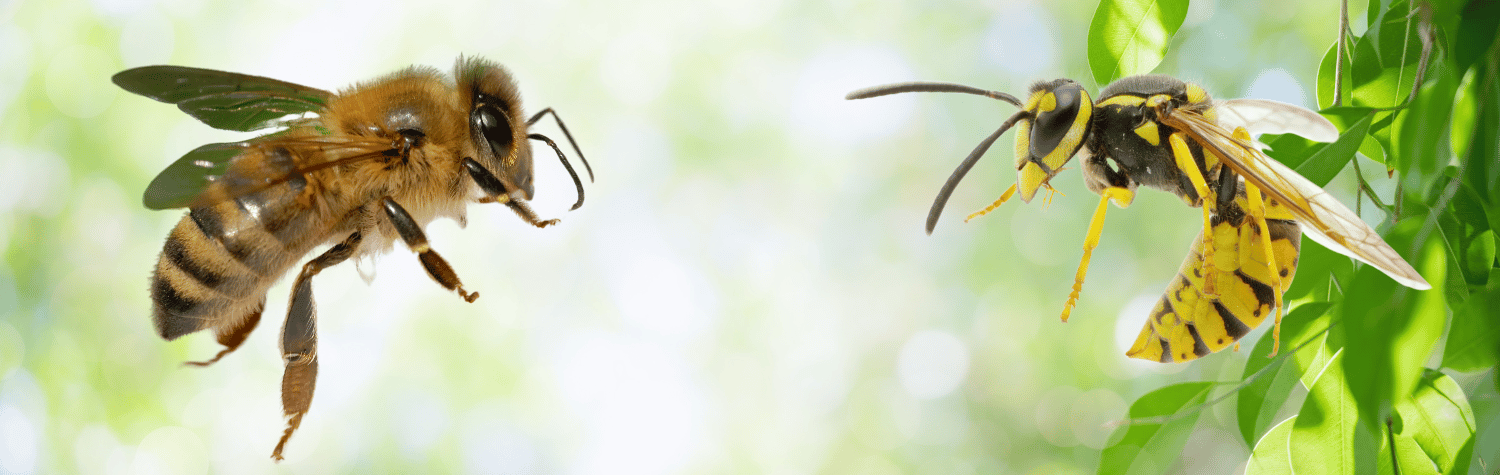
Honey bees have a more subdued golden-brown or amber coloration, with their bodies covered in a fine fuzz. This fuzz—crucial for pollination—allows pollen to adhere as they visit flowers.
Yellowjackets display a brighter yellow, contrasted sharply with black, and their bodies are sleek and shiny, lacking the fuzz that honey bees boast.
Are yellowjackets bees or wasps?
Unlike honey bees, yellowjackets are wasps, part of the Vespidae family. This key distinction helps identify them and understand their behavior.
Behavior: Pollinators vs. predators

Honey bees are gentle pollinators, essential for plant reproduction and ecological balance. They collect pollen and nectar, moving from flower to flower and playing a pivotal role in helping plants to flourish. Typically non-aggressive, they avoid humans unless their hive is threatened.
Yellowjackets exhibit aggressive behavior, especially in the presence of food. They are known to scavenge for meat and sweet substances, bringing them into frequent contact—and conflict—with humans. Their boldness during picnics and outdoor gatherings is a testament to their scavenging nature.
Do yellowjackets pollinate?
While yellowjackets aren’t known for pollination, they do provide some pollination services. As they search for nectar, they accidentally pick up and drop off pollen, helping flowers in a small way. However, their smooth bodies aren’t built for carrying pollen like honey bees, so they’re not as efficient.
Note: Honey bees harvest nectar (carbohydrates) and pollen (protein) from flowers. They are not attracted to meat.
Sting: Defense vs. aggression
Honey bees use their stings as a last-resort defense mechanism, a choice that costs them their lives. Their barbed stingers embed in the skin of their target, and when the bee tries to fly away, part of its body—including the stinger, venom sac and muscles—is left behind.
Yellowjackets are relentless when they sting. Unlike honey bees, their smooth stingers let them sting over and over without getting hurt. To make matters worse, yellowjackets often bite their target to get a firmer grip before delivering their painful stings. This ability to sting repeatedly—and aggressively—makes them far more dangerous during encounters, especially for individuals allergic to insect stings.
Fact: When a honey bee leaves its stinger behind in your skin, it also leaves behind a venom sack. You want to get the stinger out quickly, as the longer it remains in your skin, the more venom it releases.
Fact: The average person can outrun a yellowjacket, but you may need to run a fair distance. Some yellowjackets have chased people up to a mile.
Featured in this article
Shop Dr. Killigan's Essentials


Nests: Engineering marvels vs. hidden dangers
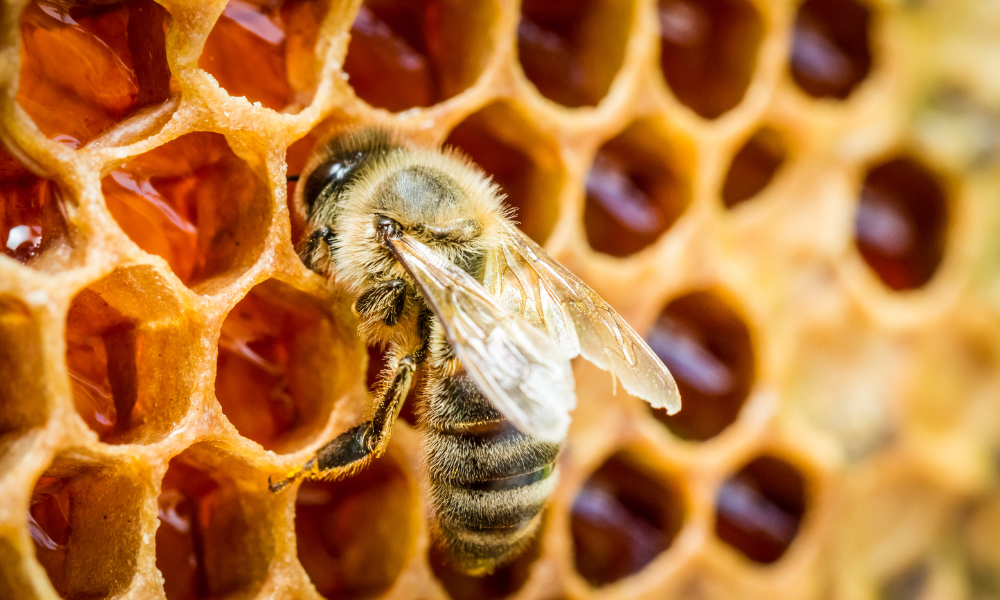
Honey bees are master architects, famed for their intricate hives made of wax and designed with precision. These hexagonal structures serve multiple purposes—storing honey and pollen and providing a haven for their young. Each hive reflects a highly organized society, with every bee playing a specific role in maintaining and protecting the community. Honey bees often build their hives in sheltered areas like tree cavities or man-made bee boxes, allowing beekeepers to harvest honey without damaging the hive.
Yellowjackets opt for a concealed approach to home building. Their nests, made from chewed-up cellulose that gives them a papery appearance, are often hidden underground or in dark, secluded areas like attics, sheds or wall voids. Where do yellowjackets nest? Typically, they build their nests in soil cavities, rotting logs or hidden spaces within structures. These nests can grow to significant sizes over the summer, housing thousands of aggressive members ready to defend their home at the slightest provocation. Unlike the exposed, honeycomb structure of honey bee hives, yellowjacket nests have a single, covered opening, making them a hidden danger for the unwary.
These nesting habits are closely tied to the seasonal survival strategies of both honey bees and yellowjackets, which adapt their behavior to thrive through the changing conditions.
Seasonal behaviors: Do yellowjackets die in winter?
Honey bees remain active year-round but adapt their behavior to the seasons. In winter, honey bees cluster inside their hives to stay warm, relying on stored honey for nourishment. This adaptation allows the entire colony—including the queen—to survive the cold months and emerge ready to pollinate again in spring.
Most yellowjackets—including workers and males—don’t survive the winter months. Only fertilized queens survive the cold months by seeking shelter in protected locations, such as tree stumps, burrows or human-made structures. In the spring, these queens emerge to establish new nests, starting the cycle anew.
Honey bee vs. yellowjacket: A comparative glance
| Characteristics | Honey bees | Yellowjackets |
|---|---|---|
| Appearance | Golden brown color with fuzzy bodies, ideal for pollen collection | Bright yellow and black, sleek, not fuzzy bodies |
| Behavior | Gentle; primarily visit flowers for pollen and nectar; avoid human interaction unless threatened | Aggressive; scavenge for meat and sweet liquids; often coming into conflict with humans |
| Sting | Sting only once, leading to death due to abdominal damage | Can sting multiple times without harm to themselves, making encounters more aggresive and potentially dangerous |
| Nests | Made of wax; house 20,000 - 80,000 bees depending on season and colony health; can be dangerous when disturbed as bees will defend their hive by stinging | Made of chewed cellulose, creating a papery material; often found underground or in secluded, covered areas; nests house thousands and can be dangerous when disturbed |
| Seasonal behaviors | Active year-round; cluster inside hives for warmth during winter, surviving on stored honey to sustain colony and queen | Die off in winter, except for fertilized queens who shelter in protected locations and reemerge in spring to establish new nests |
Fact: In their conflict for resources, yellowjackets can pose a significant threat to honey bee colonies, sometimes even overtaking weak hives.
Honey bee vs. yellowjacket: Uncovering their benefits
While it's essential to recognize the differences between honey bees and yellowjackets, it's equally important to appreciate the unique benefits each brings to our ecosystem.
Honey bees: The pollination powerhouses
- Pollination: Honey bees are among nature's most prolific pollinators, essential for the reproductive process of plants, which is vital for the production of fruits, vegetables and nuts.
- Honey production: Honey bees produce honey—a natural sweetener and food source packed with nutrients. Honey has been valued by humans for centuries for its flavor and medicinal properties.
- Biodiversity support: The work of honey bees in pollination contributes significantly to the health and variety of plant life in an ecosystem, supporting a wide range of animal species dependent on these plants for food and shelter.

Yellowjackets: The pest controllers
- Natural pest control: Yellowjackets prey on harmful insects, including those that can damage crops and garden plants—such as caterpillars and flies.
- Scavenging: While yellowjackets' scavenging behavior can be disruptive during outdoor gatherings, they play a role in cleaning up the environment. By feeding on dead insects and animal carcasses, they help recycle nutrients back into the ecosystem.
A buzz-worthy conclusion
When the buzz comes close, knowing whether it’s a friend or a foe can make all the difference. Understanding the differences between honey bees and yellowjackets helps us appreciate the important roles they play in nature. Honey bees—the gentle giants of pollination—deserve our protection, while yellowjackets—as natural pest controllers—play their part in maintaining healthy ecosystems.
By distinguishing between these buzzing insects, we can coexist peacefully and manage potential threats without harming beneficial creatures. For more insights and environmentally friendly solutions to support pollinators and control pests, check out some of our other articles. Together, we can protect our buzzing friends and ensure a balanced ecosystem.