

Published May 29, 2024 • Updated March 16, 2026
Reviewed by Julie Miller, BA in Language Arts, Editorial Lead, Dr. Killigan’s
TL;DR: Cinnamon oil, peppermint oil and clove oil can help repel ants and some may also kill them with direct contact or at high enough concentrations. Placement and consistency are important, as ants will do everything they can to bypass the treated areas or restore their trail.
Ants are persistent for a reason. Once they find food, moisture or an easy way inside, they return. That is why so many people look for a natural ant repellent.
In this guide, we’ll look at how cinnamon oil, peppermint oil and clove oil are commonly used against ants, where they help most and where they fall short. You’ll also find a simple essential oil ant repellent recipe, practical tips for stopping ant trails and a clear look at when a ready-to-use option may be the simpler choice.
What essential oils repel ants?
The three most commonly discussed essential oil options are cinnamon oil, peppermint oil and clove oil. Each works a little differently, but all three are used to interfere with ant movement through treated areas.
Still, essential oils tend to work best as part of a broader ant-control plan, not as a standalone fix.
Does cinnamon kill ants?

Yes, cinnamon oil can kill ants and may also discourage activity when applied in the right places. That said, ground cinnamon is not the same as cinnamon oil. Sprinkling baking cinnamon near an ant trail may discourage some movement for a short time, but it is far less effective than a properly concentrated essential oil.
Cinnamon oil is often discussed as a natural ant repellent because its strong scent—driven largely by cinnamaldehyde—can interfere with how ants orient themselves and move through an area. At higher concentrations, it may also help kill ants on contact.
Results depend on how well the oil is placed.
Did you know? In one study on red imported fire ants, cinnamon leaf essential oil showed both repellent and insecticidal activity, with stronger concentrations producing stronger results. Researchers also identified trans-cinnamaldehyde as a key compound behind that effect.
Does peppermint oil repel ants?
Yes, peppermint oil can help drive ants away. Its strong scent can mask the pheromone trails ants rely on, making it harder for foragers to follow the path back to food, water or shelter. Because ants rely so heavily on those scent signals, even a small disruption can throw off their movement and scatter activity along the trail.

Peppermint oil may also do more than redirect ant movement. Its key constituents—including menthol—can act as irritants and natural fumigants. When ants encounter those fumes directly, the result may be both repellency and knockdown, especially at stronger concentrations.
Did you know? A narrow spray line is easy for ants to work around. If they can cross from a nearby branch, skirt the treated surface or find a second way indoors, they often will.
From Dr. Killigan’s journal: Ants are more resourceful than they first appear. Once, while trekking through a remote jungle in Brazil, I pulled out my magnifying glass and crouched down to watch fire ants form a living bridge three feet above the canopy floor, tiny bodies stacked on top of one another and suspended in midair until the colony could surge across. It was a striking reminder of how determined insects can be when accessing a food source—or a home.
Featured in this article
Shop Dr. Killigan's Essentials


Does clove oil kill ants?
Yes, clove oil can kill ants. Among the essential oils commonly used for ants, clove oil is often valued less for rerouting ant traffic and more for its direct contact effect. Its best-known active compound is eugenol, which has been associated with fast immobilization, knockdown and mortality in ants in test settings.
While cinnamon oil and peppermint oil are often discussed for their interference with ant movement, clove oil is more often associated with a stronger killing effect. That makes it most useful where ants are already present and easy to reach.
For readers asking what essential oil kills ants, clove oil is often the clearest answer of the three.
Essential oil ant repellent recipe
A simple DIY ant repellent spray
Combine the following in a clean spray bottle:
- 1 cup water
- 1 tablespoon white vinegar
- 10 drops peppermint oil
- 10 drops cinnamon oil
- 5 drops clove oil
Shake well before each use.
How to use it: Lightly spray along active ant trails, around entry points and near the edges of baseboards, windowsills, cabinets or other areas where movement is easy to spot. Wipe away visible trails first, then apply the spray to the surrounding path and nearby gaps or cracks.
What to expect: This kind of essential oil spray for ants may help disrupt trails and discourage activity, but it is not usually a one-time fix. Essential oils fade, especially on exposed surfaces, so reapplication is often needed. For a DIY ant repellent, at least 1% peppermint oil is often suggested as a practical starting point. If ants keep returning, look again for food sources, moisture or a second route indoors.
A quick note on surfaces: Before using any DIY ant-repellent spray more broadly, test a small, hidden area first. Some essential oils can be too strong for delicate finishes or sealed surfaces.
What other natural methods help keep ants away?
Some ant species are more persistent than others, which is why a layered approach often works best. Argentine ants, for example, are especially difficult to eliminate because they can have multiple queens and interconnected nests. In practical terms, that means getting rid of one part of the problem does not always end the problem altogether.

Start by sealing the small gaps and entry points ants use to get inside, especially around windows, doors and wall openings. If ants have already found a path indoors, wipe down their trails promptly. This helps remove the markers that guide the rest of the colony back to the same route.
Pet food can also draw ants in quickly. To make it less accessible, avoid leaving food out for long periods and consider placing the bowl on a shallow plate of soapy water to create a barrier ants cannot cross.
For direct treatment, Six Feet Under® can help eliminate ants on contact while also helping you wipe away the trail they leave behind. With cinnamon oil and clove oil among its active ingredients, it offers a ready-to-use alternative to DIY sprays. On the right surfaces, it can keep killing insects that cross the treated area for up to 30 days. It is also designed to work against 50+ insect species and has a two-year shelf life when stored as directed in a cool, dark place.
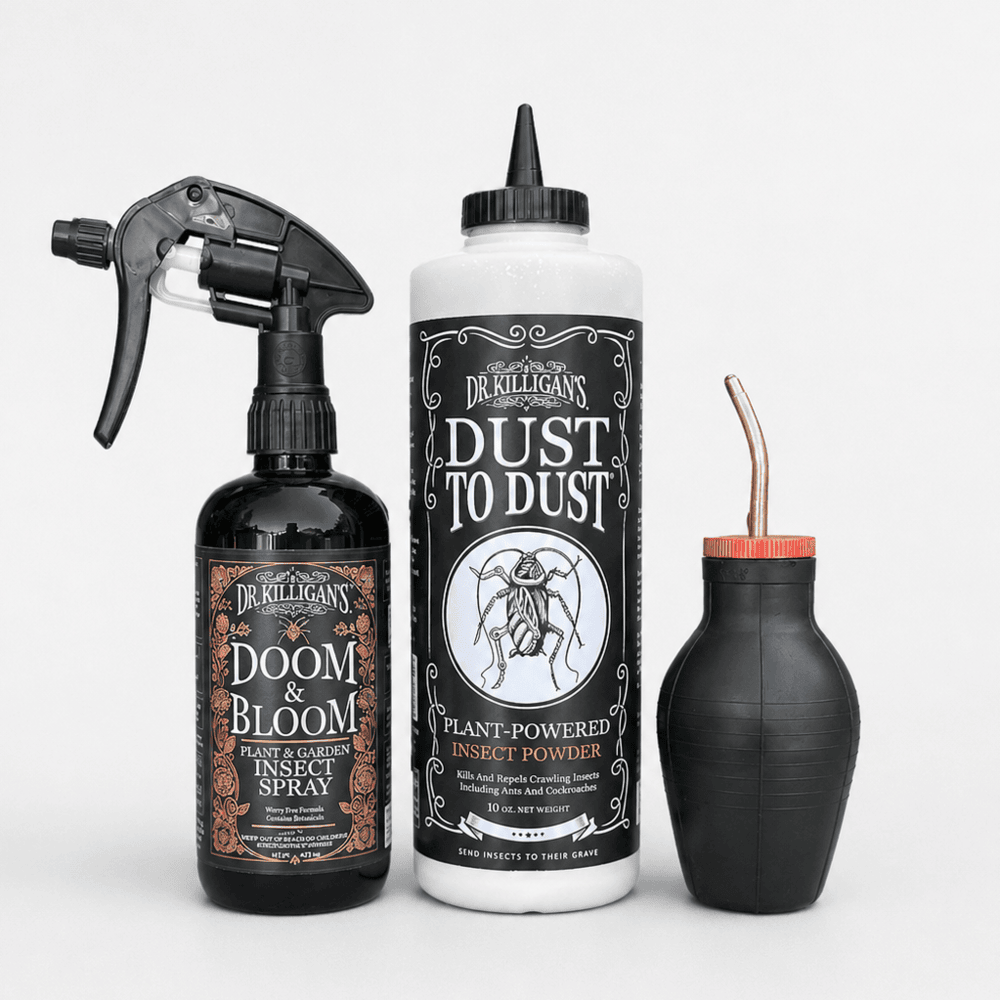
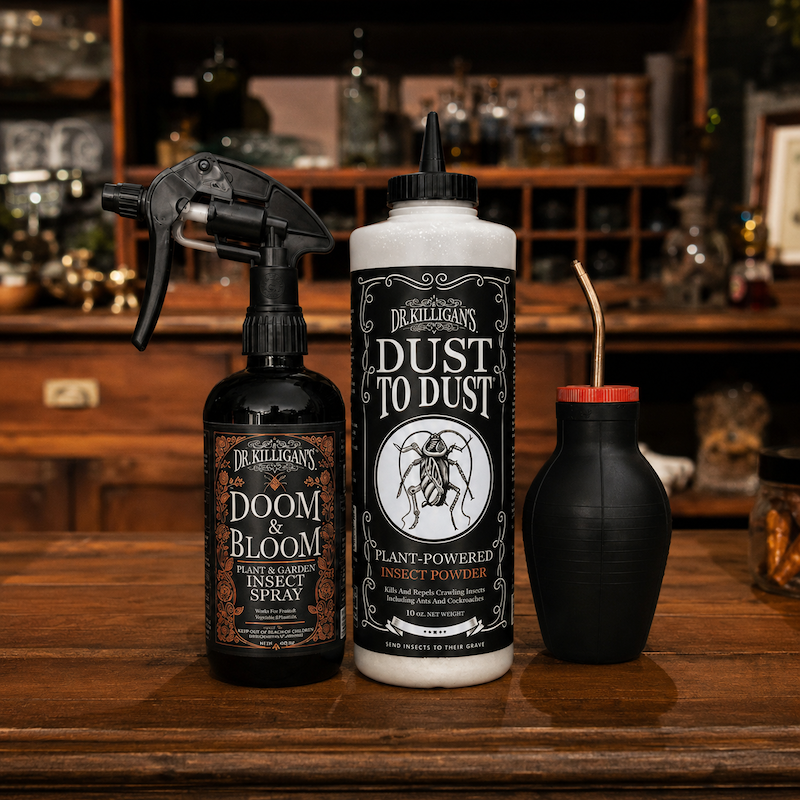
For added support around the perimeter, use an insect powder such as Dust to Dust® with an applicator like the Insect Buster. Dust to Dust is designed to target a broad range of common household ants, including Argentine ants, black house ants, carpenter ants, fire ants, ghost ants, odorous house ants, pavement ants and pharaoh ants. Applied carefully around likely entry points, it can add another layer of defense where ants tend to travel close to walls, foundations and thresholds.
For a closer look at how diatomaceous earth works and how to use it against ants, read Will diatomaceous earth kill ants? Dr. Killigan’s Dust to Dust® is a faster-acting plant-powered alternative.
Final thoughts on essential oils for ants
At Dr. Killigan’s, we believe pest control should be effective without leaning on a conventional pesticide-heavy ingredient deck. That is why we disclose all ingredients and formulate with a more careful standard in mind.
Our formulas qualify as minimum risk pesticides under FIFRA 25(b), a category the EPA says poses little to no risk to human health or the environment when the required conditions are met. It is a simpler, more transparent approach to pest control and one that reflects how we believe products for the home should be made.
Explore more
-
Will diatomaceous earth kill ants?
How diatomaceous earth works against ants and where it fits into a broader prevention plan. -
Ants in the house: what it means and what to do about it
What indoor ant activity usually means and how to respond before a small problem becomes a larger one. -
Holes in your home are attracting these insects
Why small gaps and overlooked openings can invite ants and other pests inside in the first place. -
How do you get rid of ant trails?
Why ant trails keep reforming and how to disrupt them before more ants follow.